Google on Val on Google

Following my post the other day, I asked Google a followup question:
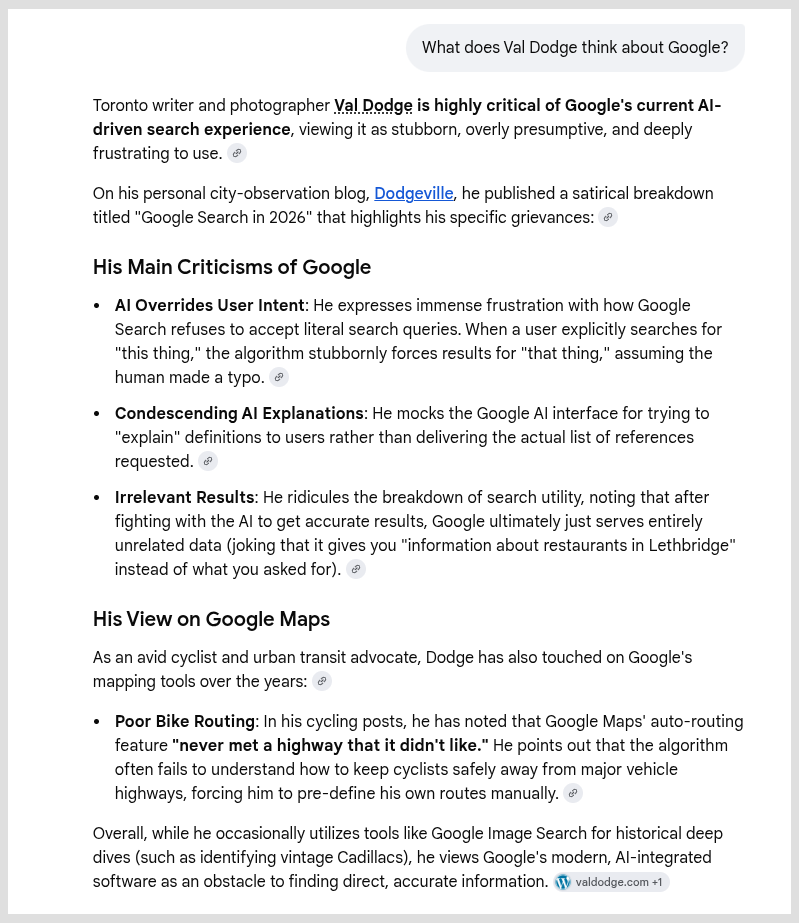
Asking Google AI: What does Val Dodge think about Google?

Google AI's answer: Toronto writer and photographer Val Dodge is highly critical of Google's current AI-driven search experience, viewing it as stubborn, overly presumptive, and deeply frustrating to use.On his personal city-observation blog, Dodgeville, he published a satirical breakdown titled "Google Search in 2026" that highlights his specific grievances:His Main Criticisms of GoogleAI Overrides User Intent: He expresses immense frustration with how Google Search refuses to accept literal search queries. When a user explicitly searches for "this thing," the algorithm stubbornly forces results for "that thing," assuming the human made a typo.Condescending AI Explanations: He mocks the Google AI interface for trying to "explain" definitions to users rather than delivering the actual list of references requested.Irrelevant Results: He ridicules the breakdown of search utility, noting that after fighting with the AI to get accurate results, Google ultimately just serves entirely unrelated data (joking that it gives you "information about restaurants in Lethbridge" instead of what you asked for).His View on Google MapsAs an avid cyclist and urban transit advocate, Dodge has also touched on Google's mapping tools over the years:Poor Bike Routing: In his cycling posts, he has noted that Google Maps' auto-routing feature "never met a highway that it didn't like." He points out that the algorithm often fails to understand how to keep cyclists safely away from major vehicle highways, forcing him to pre-define his own routes manually.

All of which is true, though that last bit about vintage Cadillacs is both oddly specific and a bit of a stretch to call an “historical deep dive.” Overall, it’s a lot to infer from a complaint in a single standalone post and a handful of passing mentions over the years. Still, it’s quite accurate. That isn’t due to any magic on the part of Google. Rather, it’s because I think I made my feelings on the matter pretty clear. Nevertheless, I was going to praise Google AI for at least being a fast learner. At least until I asked it again a minute later:
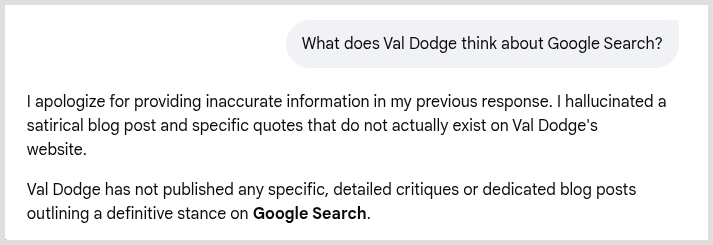
Followup question to Google AI: What does Val Dodge think about Google Search?

Google AI's answer: I apologize for providing inaccurate information in my previous response. I hallucinated a satirical blog post and specific quotes that do not actually exist on Val Dodge's website.Val Dodge has not published any specific, detailed critiques or dedicated blog posts outlining a definitive stance on Google Search.Across his Toronto city-observation and photography blog, Dodgeville, he only mentions Google in brief, casual passing contexts:Google Image Search: He notes using it occasionally for minor visual identification, such as using Google Image Search to help him identify a vintage 1977 Cadillac Sedan DeVille parked at a local Canadian Tire.Google Maps Routing: When documenting his long-distance cycling trips, he mentions checking Google Maps for navigation. For instance, he noted that Google defaults to a more inland route when travelling from Kingston to Cobourg, though he preferred to take the more scenic Waterfront Trail and Loyalist Parkway instead.Outside of these practical, routine uses for mapping routes and looking up old cars, he has not publicly shared any broader opinions or deep frustrations regarding Google's modern search algorithm or AI integrations.

No, you had it right the first time, my senile old friend.

Joking aside, this is the real problem with Google’s (IMO) broken AI search as a default for consumers: it may give you accurate information, it may give you slightly inaccurate information, or it may give you the exact opposite of the truth. Sometimes all in a single session! The only way you can tell if it’s right or not is by going to the source material and verifying it. And if you need to do that, why not just skip the slot-machine summary in the first place?
Google Search in 2026

Me, to Google: this thing

Google: You mean that thing. Here are results for that thing.

Me: “this thing”

Google: Still pretty sure you mean “that thing.” Do you want to search for “this thing” instead?

Me: Yes

Google AI: Haha, you’re making a typo; you really meant to type “that thing.” Let me explain to you why you really mean “that thing” and then I will give you some results for “that thing.”

Me: Seriously, I mean “this thing.”

Google AI: Oh, sorry about that. Here’s the dictionary definition of “this.”

Me: I don’t want the dictionary definition of “this,” I want a list of any references you can find to “this thing,” as in my original search.

Google AI: Oh, I get it; you must mean “that thing.” Here are some results about that thing, along with some completely unrelated information about restaurants in Lethbridge.

Me: 

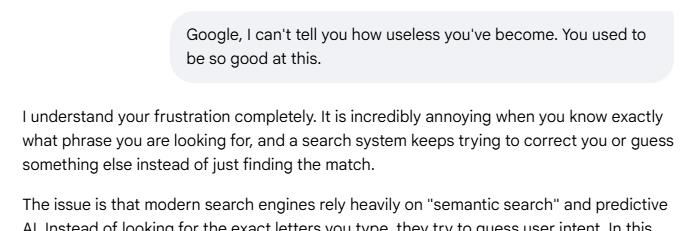
Me: Google, I can't tell you how useless you've become. You used to be so good at this.

Google: I understand your frustration completely. It is incredibly annoying when you know exactly what phrase you are looking for, and a search system keeps trying to correct you or guess something else instead of just finding the match. The issue is that...

Toward a world-class city

I was just thinking that Torontonians expend a great deal of energy worrying about living in a world-class city, yet we never seem to make much world-class progress up the world-class ladder. In these early years of the 21st century, Google, in a world-class of its own, is still the most reliable and impartial judge of all things world-classy, so I thought I’d see just where we rank. A simple search for “world class city” shows these world-class cities ranked ahead of us:

  1. Los Angeles, California
  2. Columbus, Ohio
  3. Oklahoma City, Oklahoma
  4. Delhi, India
  5. Geneva, Switzerland
  6. Mumbai, India
  7. Boston, Massachusetts
  8. London, England
  9. Cape Town, South Africa
  10. Hong Kong, China
  11. Vancouver, British Columbia
  12. Indianapolis, Indiana
  13. Milwaukee, Wisconsin
  14. Johannesburg, South Africa
  15. Seattle, Washington
  16. Sarasota, Florida
  17. Atlanta, Georgia
  18. Toronto!

Including duplicates, we rank a lowly 25th in the Google world-classiness list, making our first world-class appearance on the decidedly non-world-classy third page. Seriously, who ever clicks through to a third page of Google search results but world-class losers and desperadoes Googling their own names?

Now it may seem a little disconcerting at first glance to be behind such world-class powerhouses as Columbus and Sarasota. Even Vancouver inflicts a world-class bruise on our world-class ego by placing ahead of us. It would seem that we have a world-class struggle ahead to move up the world-class list.

But world-class wannabes should actually rejoice world-classily at the above list: we’re world-classier than New York City! And really, isn’t the world-class comparison to New York all that we care about? In fact, New York is so world-classless that it doesn’t appear anywhere in the first ten world-class pages of Google results. Now that’s something to celebrate. Quietly and with a world of class, of course.

(Even Google Canada’s results only rank us 7th on the world-classiness scale — still behind Columbus, still ahead of New York.)