Dodgeville

Random Wanderings and Wonderings

Posts tagged: trails

Upper Canada Heritage Trail

By , December 4, 2012
Upper Canada Heritage Trail in Niagara-on-the-Lake

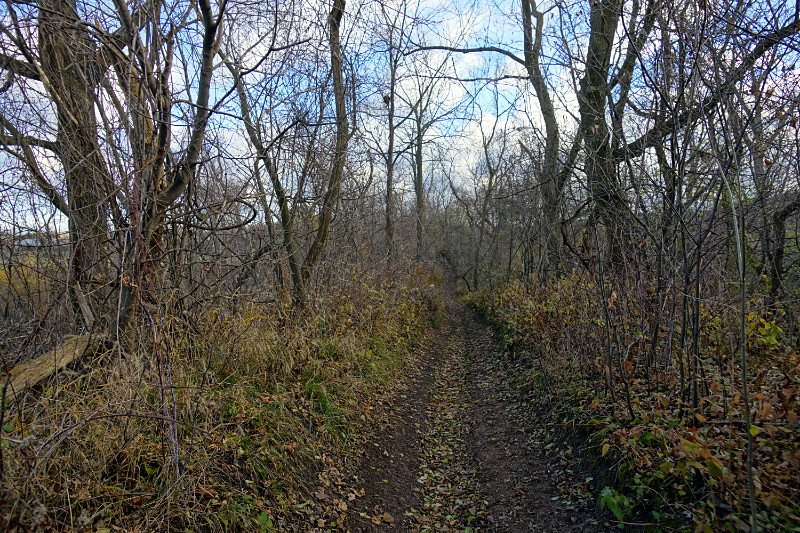
The first leg of the Upper Canada Heritage Trail looks like many other rail trails.

Upper Canada Heritage Trail in Niagara-on-the-Lake

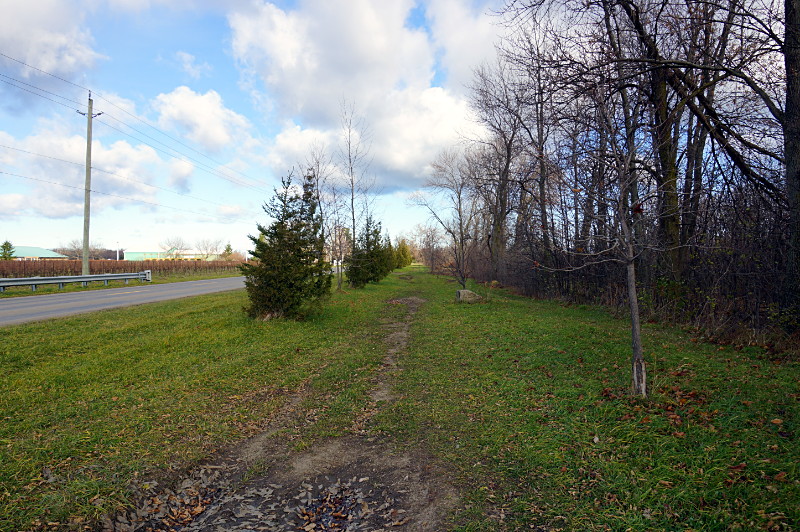
The majority of the trail runs beside Concession 1 and passes numerous orchards and vineyards.

Risa attended a meeting in Niagara-on-the-Lake last weekend and I tagged along for the drive down the QEW so that I could take a walk down an old railway, now the Upper Canada Heritage Trail. It travels about 11 km from the Bruce Trail west of Queenston down to the Waterfront Trail on Lake Ontario. Combined with the first few kilometres of the Bruce Trail from Queenston Heights and the General Brock Trail along the Niagara River, it constitutes a day-long hiking loop over mostly easy terrain. The UCHT would definitely be the quieter side of the loop, especially at this time of year.

Risa tossed me out of the car at the trailhead at York Road and Consession 2 and told me I had three and a half hours to get to Fort George or I’d be walking all the way home. The terrain was about what you’d expect in a rail trail: mostly flat, mostly straight, and mostly running behind farms. A portion of the trail just north of York Road was completely washed out: about 20 metres of the raised railbed had collapsed into a jumbled mess of trees, dirt, and rocks below. The resulting hole is navigable on foot with sturdy boots and a bit of care, but don’t expect to pass with your bike or horse. Several large potholes and a subsiding trail leading up to the washout hint that much more of the old railbed here is probably going to collapse in the near future.

The long middle stretch of the trail runs dead straight and flat beside Concession 1 and is a pleasant walk alongside a quiet country road lined by numerous vineyards and orchards. Autumn is usually my favourite time to go hiking but this portion of the trail would probably be much nicer in the late summer with the sights and smells of all the fruit coming into season.

Upper Canada Heritage Trail in Niagara-on-the-Lake

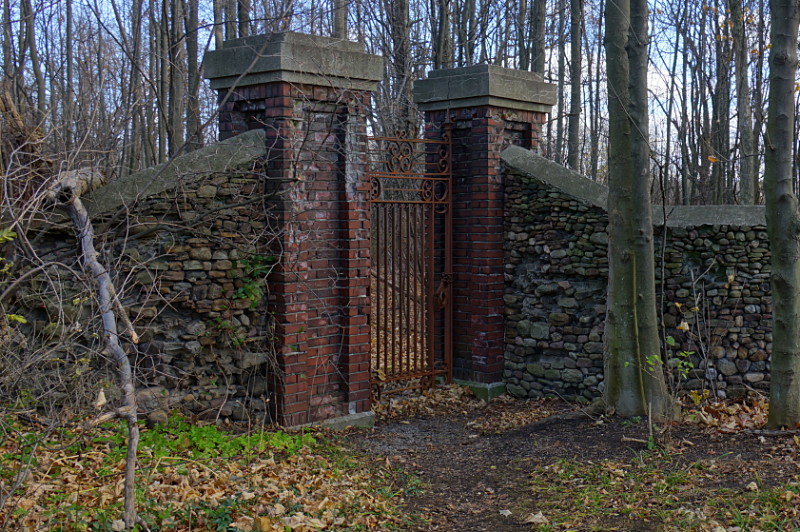
The third section of the trail curves up through suburban Niagara-on-the-Lake heading toward downtown. It feels like more of an urban rail trail, with numerous well-kept backyards opening right up onto the trail. Just imagine having a section of the Bruce Trail literally outside your back door. This section is also home to the most interesting sight on the trail, a long stone wall. It looks long abandoned and neglected at first, but it does still separate private homes from the trail. Numerous sections have fallen down and been replaced by ugly wooden or chain-link fences,  while another portion would have fallen over if it weren’t propped up by three large metal beams.

The trail ends at the Waterfront Trail, a short walk away from downtown Niagara-on-the-Lake and Fort George. All in all, it’s a nice walk, if not a challenging hike.

Waterfront Trail expanding to Lake Erie

By , November 27, 2012

The Waterfront Regeneration Trust, which manages the Waterfront Trail along the length of Lake Ontario, is expanding it to include the Lake Erie shore starting next year. This has probably been in the works for a while, but the news seems to be flying below the radar so far.

I don’t expect the trail to emerge next spring as a finished entity along the entire Lake Erie shore, but adding 620 km of signed on- and off-road trail is a huge step forward. A lot of cyclists in Ontario (myself included) salivate at the thought of our own Route Verte connecting the corners of the province. A lot of the infrastructure is already in place, with numerous long-distance trails radiating across many regions of the province. Some of them are already managed as pieces of larger trail networks like the Waterfront Trail, the Central Ontario Loop Trail, and the Trans Canada Trail. Still, completing a provincial network wouldn’t be trivial: some trails would need to be need to be improved to be suitable for casual cyclists and filling in the missing links would need to be prioritized. Closest to home, Toronto suffers from relatively poor connections to out-of-town trails. The Waterfront Trail is nice, but won’t get you to the numerous bike routes that start north of the city. That’s one reason I like the hydro corridors so much: they’re quiet routes through the most car-centric parts of the city and have tremendous potential for linking to trails beyond Toronto’s boundaries. We need more of them.

With the Lake Erie extension, I hope that the Waterfront Trust has learned some lessons from 15+ years of wrangling the trail along Lake Ontario. Here are two improvements I’d like to see applied to the trail on both lakes:

  • Follow an obvious and sane route. I’ve ridden the Waterfront Trail through Oakville a number of times and have never been able to follow the official route. It seems to constantly duck onto short side streets for one or two blocks before coming right back up to Lakeshore Road. The route may travel one block through a park that is otherwise two blocks away from the through-route. The little jogs just add distance and confusion to the overall route and make it incredibly easy to get lost. The situation is the same in parts of St. Catharines, Toronto, and probably elsewhere. I’d much rather just have a relatively straight route than one that takes me two blocks out of my way so that I can ride for one block on a quiet street that’s still nowhere near the water. A cyclist shouldn’t need to consult a map to follow a signed route, any more than a driver should need a map to drive straight on the 401.
  • Have more visible and more consistent signage. One of the reasons it’s so easy to lose the trail as it zigzags from street to street is that many directional signs are so small that they border on invisible. The small size is compounded by the fact that many directional arrows are pale orange on a tan background and don’t exactly call your attention to them. You’ll never see one unless you’re actively looking for it. I understand that there was some NIMBY resistance in the early days of the Waterfront Trail, but surely it’s well-established now and can push communities for better signage. Signs have improved in a lot of areas, but there’s still much work to do.

Bridge from the past

By , April 20, 2009

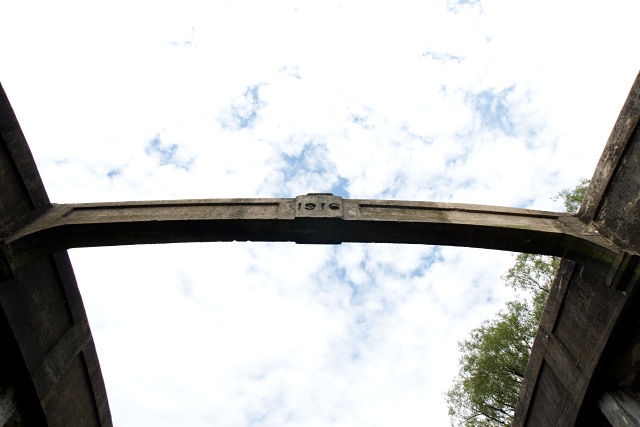
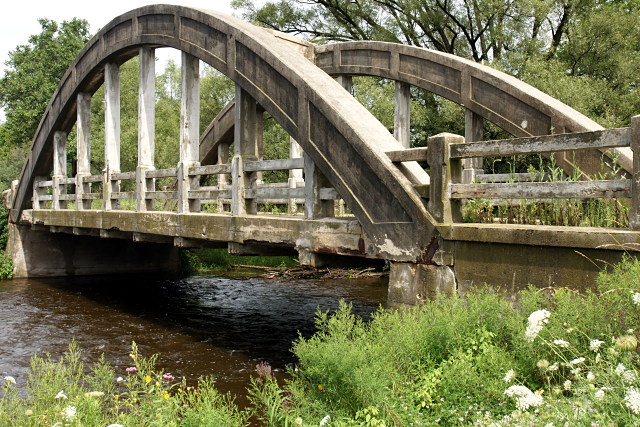
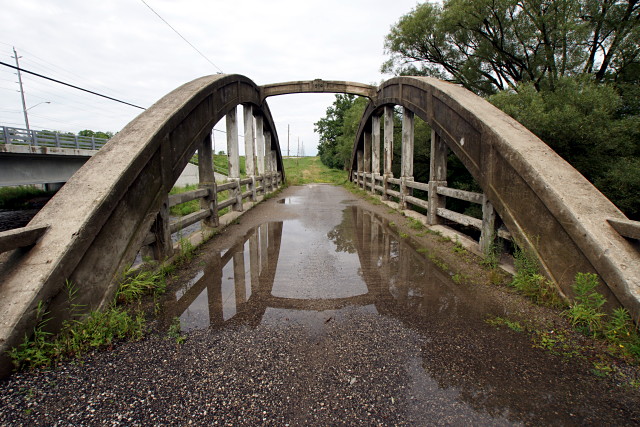
Concrete bowstring bridge outside Guelph

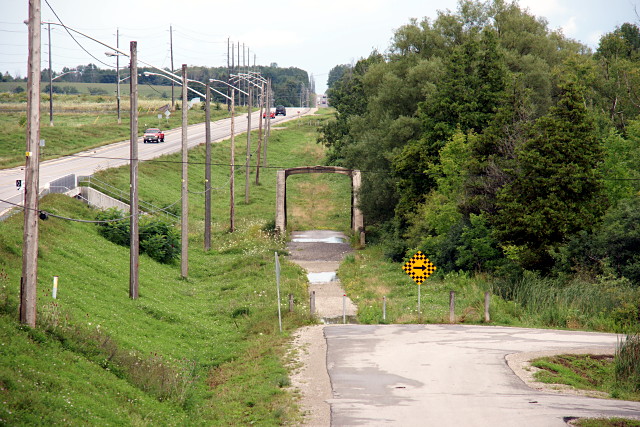
If you’re anything like me, sometimes you see something at the side of the road that you just have to stop and check out. This is a prime example from last year: a concrete bowstring bridge beside the current alignment of Stone Road outside Guelph. According to the crossbar, it was built in 1916.

Concrete bowstring bridge outside Guelph

The modern bridge that carries Stone Road today was built in 2005, but it’s difficult to believe that the old bridge was still carrying cars just four years ago; it looks like it’s in pretty rough shape.  The bridge was designated as a heritage structure in 2003 (PDF) and became part of a walking trail along the Eramosa River after Stone Road moved a few metres north to the new bridge.

Concrete bowstring bridge outside Guelph

Concrete bowstring bridge outside Guelph

I don’t know when we stopped building this kind of bridge, but I think the two that still exist in the Don Valley date from around the same era as this one. The sight of a concrete bowstring bridge always makes me smile; they seem to strike the perfect balance between elegance and industry.

Hosting provided by Finite Digital Inc.