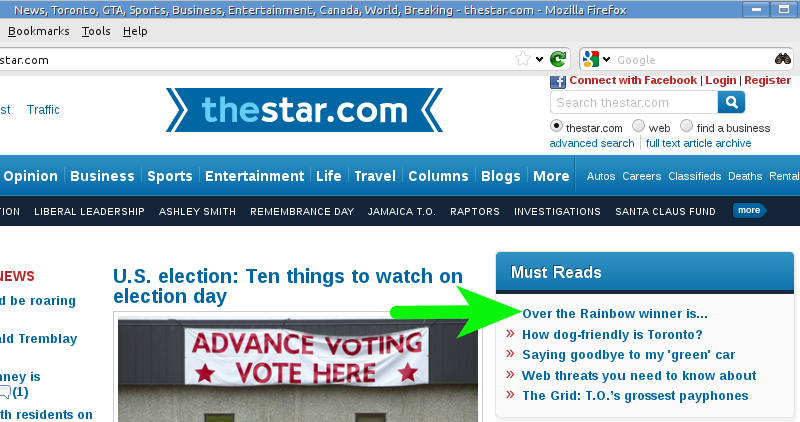
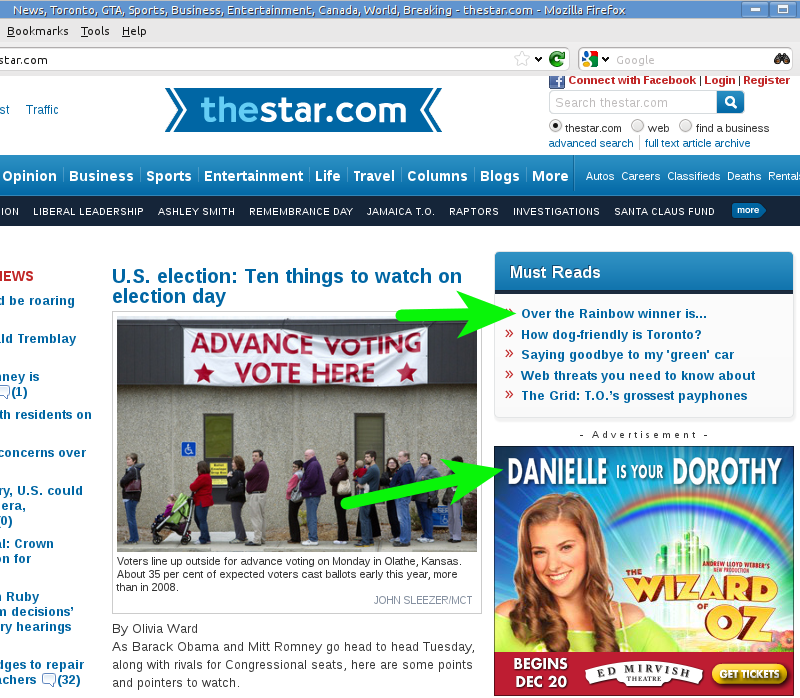
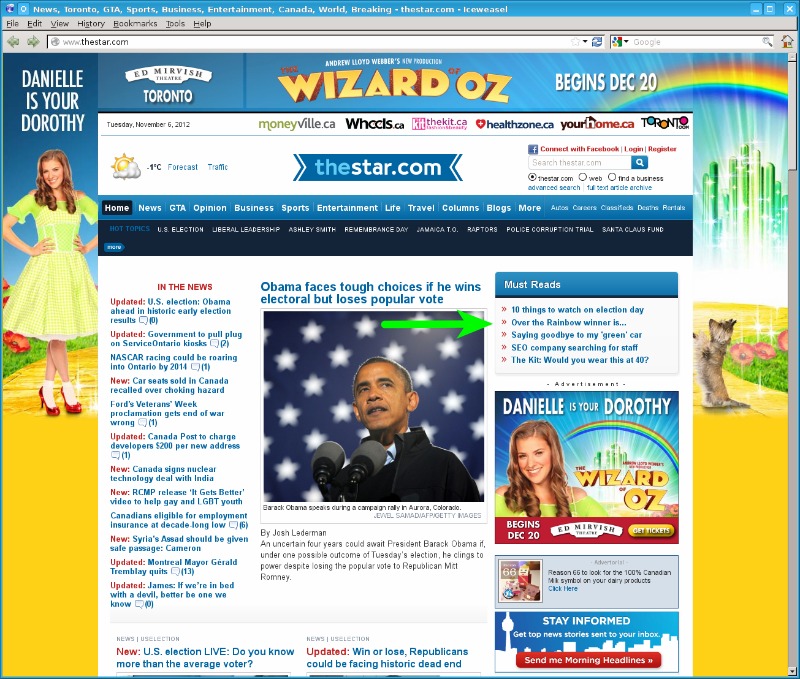
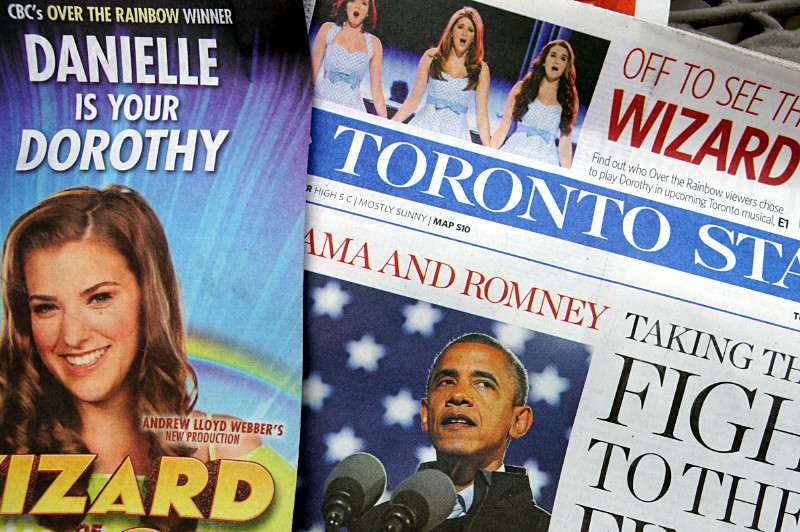
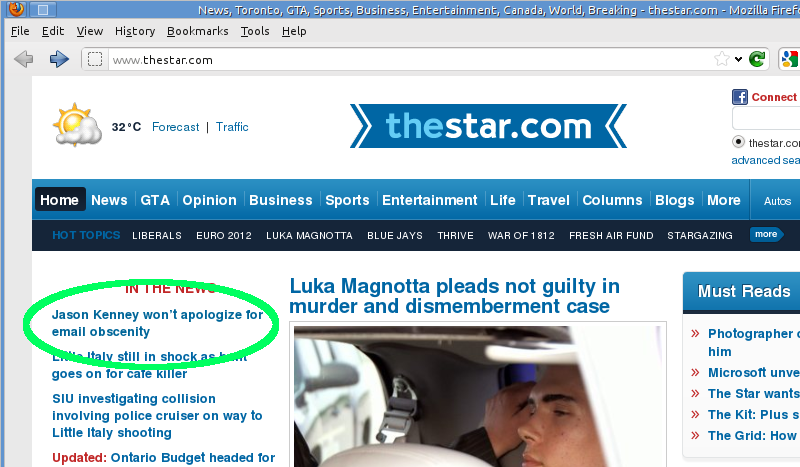
Kathy English, the Star‘s public editor, dedicated her column today to addressing my complaint about headline switching on its website.
In her column, English reported that the journalist who wrote the story had misunderstood the council vote and only realized her error after the story went live on the Star‘s website. The reporter and her editor updated the online story and headline without noting the significant change in the article. I’m not sure if that’s any better than my original thought on seeing the flip-flop, which was that the Star had prepared two headlines and accompanying stories in advance and had simply posted the wrong one. Neither option is an excuse for not posting a correction on something like this.
Clarifying that the Star‘s corrections policy does apply to the web site, English wrote:
The Star’s accuracy and corrections policy applies to all content on all platforms. It says that errors, in print or online, must be corrected clearly, promptly and prominently. It also states, “Building trust in the digital world demands that the Star is seen to be transparent.”
[...]
In recent months, I’ve grown increasingly concerned about the Star’s level of transparency about online errors, having come across far too many examples of the newsroom “fixing” stories without acknowledging mistakes.
I’m quite surprised to discover that the Star‘s corrections policy holds the website to the same standard as the print edition, and can only assume that its requirements are disregarded by a significant proportion of Star writers and editors. I’ve lost count of how many silent corrections I’ve seen on the Star‘s website. I may laugh at spelling mistakes and nonsensical sentence fragments, but getting a story plain wrong and then not owning up to it is just too much.
Call me old-fashioned, but I believe that online media should be held to the same standard as any other media when it comes to accuracy. When an error is made, a correction should be noted and published. Both online-only publications like Slate and traditional broadsheets like the New York Times adhere to this standard for web content. Locally, Torontoist started doing it in January 2008 under then Editor-in-Chief David Topping and remains one of few, if not the only Toronto media outlet that reliably appends public corrections to articles that originally contained errors ranging from misspelled names or misstated dates all the way up to mistaken facts. It’s kind of sad that four years on, major media in this town is still catching up.
[January 28 update: the Star's public editor addressed my complaint in her column today. Here's my reaction.]
[January 26 update: the Star finally prepended a correction to the article yesterday, more than a full day later. I'll have more to say about it in a couple of days.]
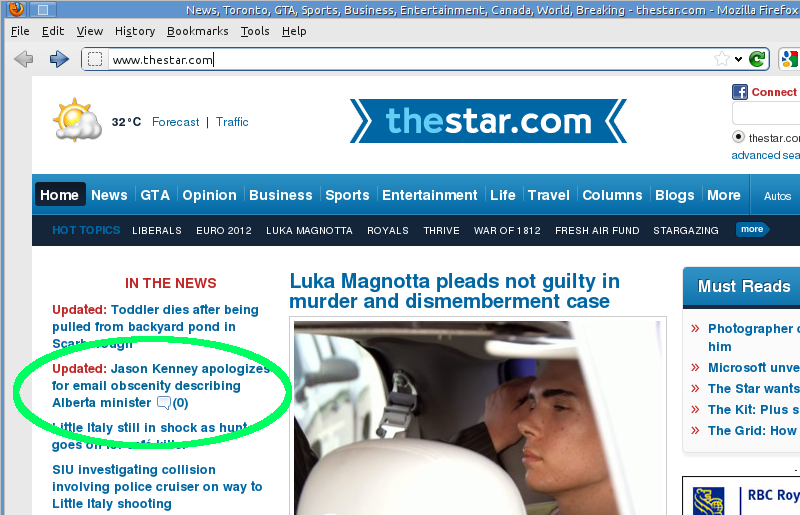
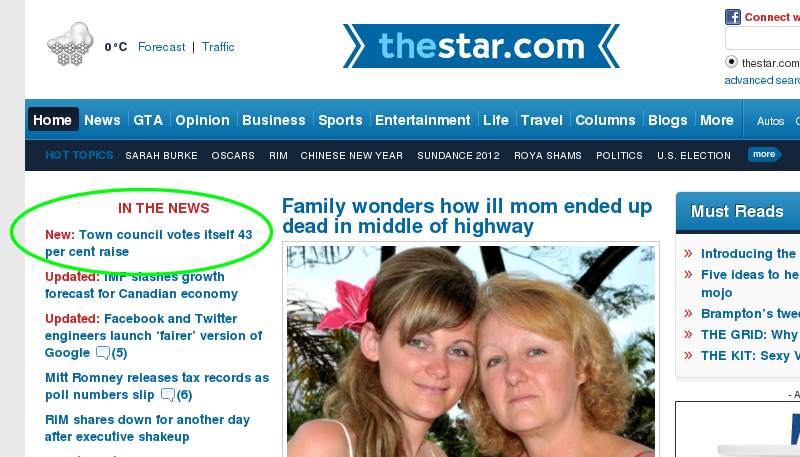
Although the Star is somewhat notorious for its editing mistakes, it’s not often that you see the same story covered under two completely contradictory headlines. But such was the case today when a story about a raise for town councillors in Whitchurch-Stouffville first appeared and was later updated:

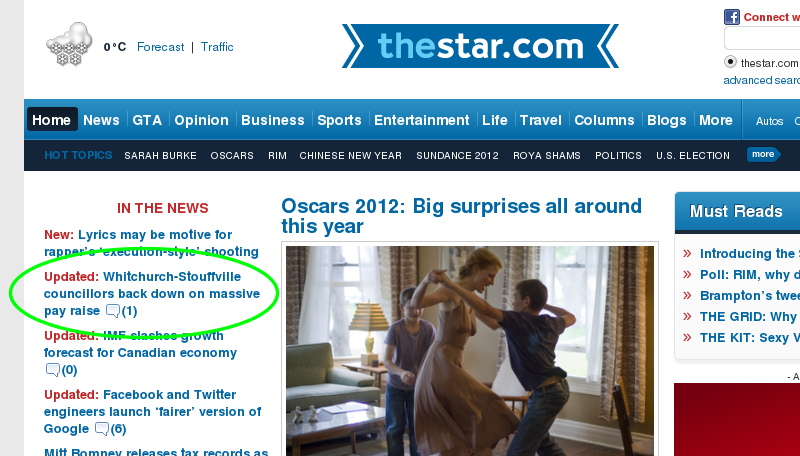
Half an hour later:

I didn’t have a chance to read the first version of the story, but it’s clear that at least a couple of the early commenters on the article saw a story about a 43% raise. Based on the headline alone, a correction should be appended to the online article. No such luck. It’s worth noting that the URL for the story also changed, from:
http://www.thestar.com/news/article/1120332–whitchurch-stouffville-council-votes-itself-43-per-cent-raise?bn=1
to:
http://www.thestar.com/news/article/1120332–whitchurch-stouffville-councillors-back-down-on-massive-pay-raise?bn=1
Both URLs currently take you to the same version of the story, but that’s only because to the Star‘s chosen content management system, this is also a valid link to the story:
http://www.thestar.com/FakeNews/article/1120332–the-toronto-star-cant-get-its-story-straight?bn=1
A lot of minor corrections are fixed silently and go unnoticed, but an error on this scale requires some sort of acknowledgement.
I’ve written an email to the Star‘s public editor, Kathy English, in the hope that this kind of situation may be addressed in the future.

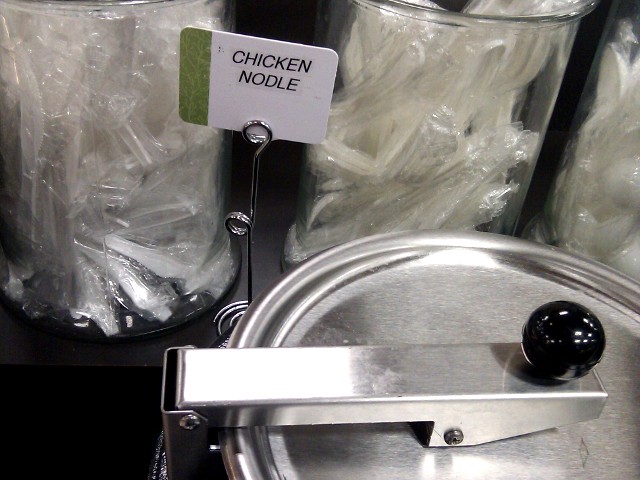
Call me what you will, but I don’t think that expecting properly spelled food labels in the local Sobeys is asking for too much. Everybody makes mistakes (guilty!), but is it really possible that no employees or managers noticed this label all day long yesterday? Or is it more likely that the staff noticed but just didn’t care enough to fix it? Either way, it doesn’t exactly give me confidence that Sobeys treats my food with any greater care than, say, the local Loblaws.

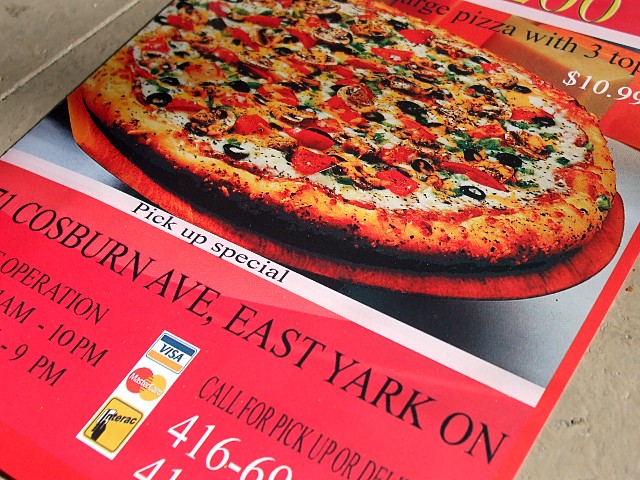
I can’t help but channel my best Fargo accent whenever I read the location on this pizzeria’s flyer.
As funny a mistake as that is (and as much fun as it is to say “East Yark” over and over and over again), the sad part is that an earnest businessperson is probably losing a significant chunk of potential business from people who think that if you can’t take the time to spell-check the name of your neighbourhood, you can’t be putting much care or attention into cooking pizzas either.
My mother mused for a while about starting a side business doing nothing but quick proofreading of flyers and brochures for local businesses before they get printed and distributed with howlers of mistakes on them. For a few bucks, she’d make any necessary corrections before releasing the work to the printer. She got started by correcting flyers that she received and sending them back to the offending business along with a business card and a brochure of her own. She eventually gave up after getting no responses and continuing to receive misspelled flyers months after she sent in her free corrections. But there must be a viable business in here somewhere, even if only for a printer who looks at the client’s copy and says, “Hey, wait a sec…” instead of just shrugging and starting the press.

It’s not every day that you read a story about Tim Berners-Lee that doesn’t mention his primary claim to fame, that he invented the World Wide Web. It’s even less frequent that you see him referred to as a “climate-change expert” without mentioning his long history in computing. That would be because the author of How Bad are Bananas?, the book featured in this story in today’s Star, is not Tim Berners-Lee as identified in the third paragraph, but is in fact Mike Berners-Lee. The Star has already issued a correction and fixed the online version of the story, but I predict ongoing confusion for poor Mike: Amazon.ca currently catalogues the book under Lee M. Berners.
Also listed in the Star‘s correction today is a story about thorium, which originally stated that it has two fewer atoms than uranium. Let’s see, if uranium has one atom and thorium has two fewer, would that make thorium, with its -1 atom, antimatter? No wonder people are so excited about it.

The problem with hand-written signs is that there’s no spell-check to fall back on. This sign in a local Loblaws, which combined two errors in one word, was the very first thing customers would see upon entering the store a couple of weeks ago. Spelling flames aside, it created the impression that the people there just don’t care: whoever wrote the sign couldn’t be bothered to check the spelling of a common word and either no one else noticed or they didn’t say anything. It certainly makes me even warier than usual when it comes to trusting that the food isn’t mouldy or short-dated.

I’ve seen a lot of misspelled signs, but never one quite like this. I can’t even come up with something suitably snarky to say about it. There must be a joke here that’s going over my head.

Among the various disclaimers and warnings in the manual that accompanied a new Bluetooth headset was this oddity:
Do not place this unit in a place exposed to humidity, dust, soot or steam, subject to direct sunlight, or in a car waiting at a traffic signal. It may cause a malfunction.
Huh? I’ve seen my share of odd warnings, but warning against using something “in a car waiting at a traffic signal”? This is new to me. So assuming I have this thing in my car while I go from A to B, what am I supposed to do when I reach a red light? “Yes, I saw the red light officer, but do you know how dangerous it would have been for me to stop? I have a bluetooth headset in my bag!”
For the record, Sony informed me that this is an error in the manual and it’s meant to caution against using the headset while driving. I’m not at all sure how that would “cause a malfunction,” though. Either way, I’d say that this warning is a good argument against writing owner’s manuals while in a car, whether driving or stopped at a red light.

The introduction to the otherwise standard warning on this plastic bag would seem to illustrate the perils of sending an email to a translation service and blindly accepting the result. It reminds me of this prime example of a translation request gone awry, though on a much smaller scale, of course.
R.E. Dietz, famous American manufacturer of hurricane lanterns, is run out of China these days.

This wayfinding sign recently appeared on the Belt Line, just outside the entrance to Mount Pleasant Cemetery. At least the arrow, complete with hand-lettered spelling correction, is pointing in the right direction, unlike some other signs I could mention. There’s an old saying in woodworking: measure twice, cut once. Surely there’s a similar axiom in the sign-making business.