Feed on
Posts
Comments

Archive for the 'Pedestrians' Category

 Boldly going where no pedestrian has gone before

I’ve long thought that there must be some provincial regulation requiring municipalities to install pedestrian signals whenever they reconstruct a signalized intersection. I’m all for the idea, but implementations sometimes trend toward the bizarre.

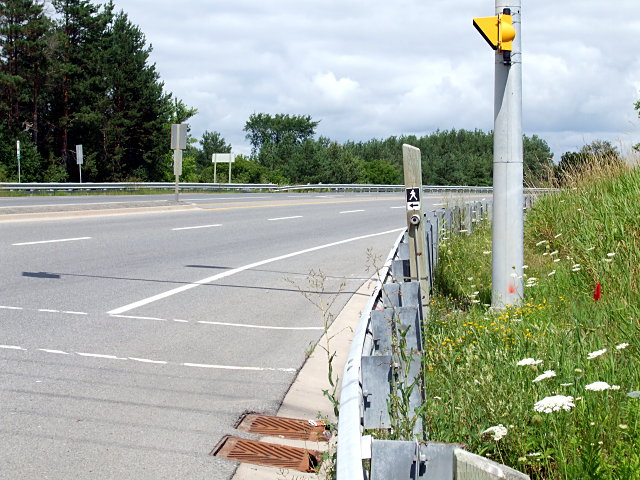
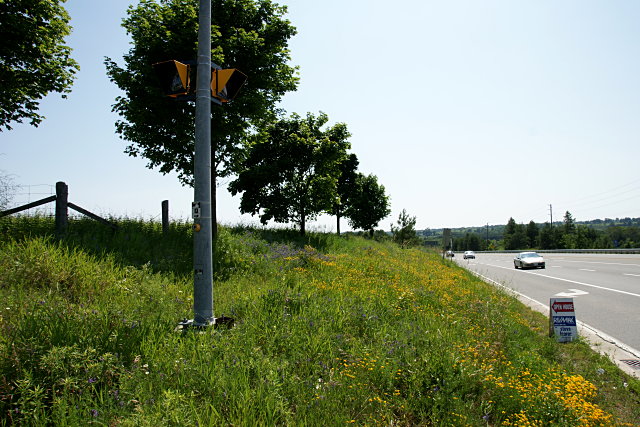
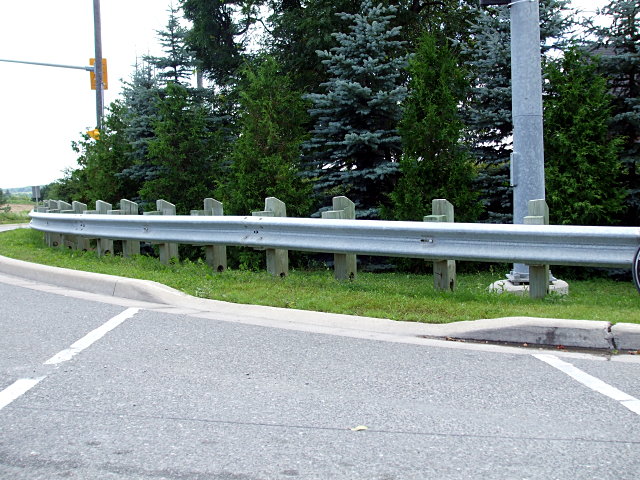
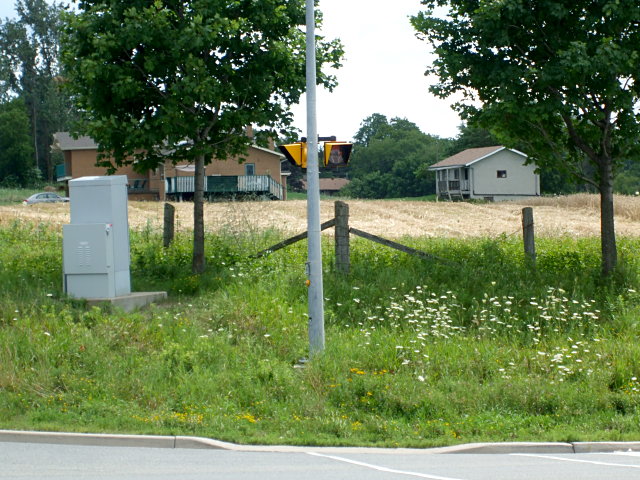
Take, for example, the intersection of Highway 7 and Westney Road in rural Pickering. It’s near the hamlet of Greenwood, with Valley View Public School just down the street and the Pickering Museum a country block away, but I highly doubt that more than a couple of pedestrians grace the intersection on the busiest of days. There are no sidewalks anywhere around here. Yet pedestrian signals and their activation buttons stand guard over each corner of the intersection, just waiting to be pressed by the hapless soul who finds himself lost here. So far so good. But when you look closer, you realize that with no sidewalks and corrugated beam barriers sheltering the buttons at three corners, the only way to activate them is to stand on the road. On the fourth corner, pedestrians have to climb a small weedy hill to press the button:

An inconvenient button

But even better than the activation buttons are the curb cuts, dutifully guiding people in wheelchairs and with baby strollers into the guardrails and onto non-existent sidewalks:

Curb cut to nowhere

Curb cut to nowhere

The whole thing smacks of some bureaucrat following the letter, but not the spirit, of the law.

Permalink

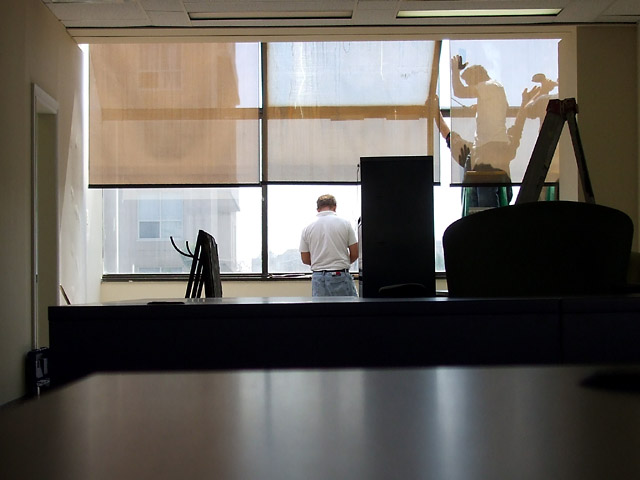
Replacing a window

Stop! You know there are people down there, eh?

One of the members of the crew replacing a 5th-storey office window, to another member of the crew who was chipping the old broken pane out with Vise-Grips and raining little glass shards onto the sidewalk below.

Permalink

A member of one of my mailing lists recently posted a link to a story at the Daily Mail called How children lost the right to roam in four generations. It looks at four generations of a family in Sheffield and examined how far from home children of each generation were able to wander from home unaccompanied. The great-grandfather was allowed to walk six miles to the local fishing hole at the age of eight, while his eight year old great-grandson is now only allowed to roam within a 300-yard radius.

The gradual erosion of kids’ freedom is so universally accepted that it’s not really news. But what makes the Daily Mail article so compelling is the graphic that accompanies the story: it overlays a map with the roaming area of the four eight-year-olds, showing how dramatically children’s worlds have been shrinking.

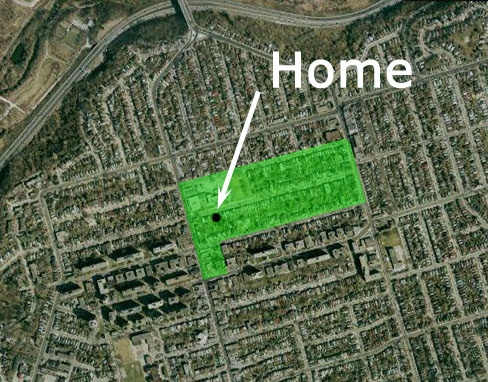
With that in mind, I’ve taken a Google map satellite image of my old neighbourhood in East York and overlaid my own roaming area as an eight-year-old in the late ’70s. The result is the graphic below.
My roaming limits as an 8-year-old

The farthest from my home that I was allowed to venture alone was a little over 500 metres. But within that 500 metres were two playgrounds, a school yard, a swimming pool, a wading pool, a library, numerous stores, a restaurant, a haunted house (or so we imagined), and most of my friends.

Venturing farther afield or crossing any of the local main streets required being accompanied by an older friend or family member. We moved to Scarborough the next year, where my authorized roaming radius increased to well over a kilometre; my unauthorized radius, previewing the explorer I would eventually become, was larger still. When we moved back to East York three years after that, my catchment area expanded to virtually anywhere the TTC, my bike, and my twelve-year-old feet could take me.

How far were you allowed to wander as an eight-year-old?

Permalink

The Toronto Police issued a press release (thanks to Martino for the link) on Sunday announcing the start of Operation Safe Journey, a week-long blitz against drivers and cyclists who endanger pedestrians. Bravo! But tellingly, the press release also promises to target “pedestrians who fail to obey traffic signals or who fail to yield to traffic.”

If you believe the CityNews take on the crackdown, it’s aimed almost entirely at pedestrians. City’s story typifies the blame-the-victim mentality of the media and the police, stating, “Many of those killed last year were guilty of crossing the street in the worst possible place and at the worst possible time.” Mmm, smells like Rob Ford. Yes, it’s your own damn fault if you venture into the city without a car. You’ve got some nerve, not waiting (and waiting, and waiting…) your turn to cross the street. Don’t you know that streets are for cars?

So as a public service to the Toronto Police, I’m rewriting their press release. This is how it should read:

In 2006, there were 57 traffic fatalities in the City of Toronto. Thirty were pedestrians, with one−third of them over 65. In contrast, 38 people were killed by guns in the City of Toronto in the same period.

These were tragedies that need not have occurred.

As members of our society and as road users, whether as pedestrians, cyclists, or motorists, we share a responsibility for preventing these tragedies.

Motorists must exercise more caution when manoeuvring their 2-tonne vehicles around the city, and remember that pedestrians don’t have crumple zones, air bags, or seat belts to keep them safe in collisions. In fact, in your haste to be the last car turning through the advanced green a full 5 seconds after it stopped flashing, or make that right turn without looking where you’re going, or zip past the bus stopped in front of the crosswalk, you’re putting pedestrians’ lives at risk. Oh, and your premiums may go up a little after your insurance company pays a few thousand dollars to scrape a dead pedestrian out of your grill.

Being in a car does not automatically give you the right of way. Shaving a few seconds off your mad cross-town dash isn’t a good enough reason to endanger someone’s life. Just because a pedestrian isn’t in a car doesn’t mean that she isn’t in as much of a rush as you are to get to where she’s going.

Pedestrians should remember that many motorists don’t see you unless you’re inside a shiny metal box on four wheels. Many of those that do see you consider you to be a nuisance, serving no purpose but to delay them on their appointed rounds. The motorists who do treat you with the respect you deserve risk being rear-ended by all of the other motorists. Please look both ways before you cross the street.

On Monday, March 19, 2007, the Toronto Police Service will embark on a one−week education and enforcement campaign entitled “Operation Safe Journey”. This campaign will target motorists whose aggressive driving habits endanger the safety of pedestrians.

And next week, we’ll be running Operation Safe Shootings, a blitz targetting people who get shot. It’s their own fault, you know.

Of course, what they really wanted to write probably looks something more like this:

Hey Pedestrians! Get outta the way!

Note for the argumentative: I am a motorist, cyclist, and pedestrian, though not necessarily in that order. Of the three groups, motorists have the largest burden to act responsibly because of the amount of damage they can inflict on the other two groups when something goes wrong. Yes, there are irresponsible cyclists, and irresponsible pedestrians, but let’s be honest about where the responsibility lies.

Permalink

In a story last week, The Fixer touched on one of my pet peeves: pedestrian signals at intersections that don’t change with the traffic signal unless you press the button. Now I understand that many signals in the city won’t change unless a vehicle is waiting or a pedestrian presses the button. That’s not what’s at issue. The problem here is that when a vehicle is present and causes the light to change, the pedestrian signal doesn’t change to “walk” unless a pedestrian also presses the button. The reverse is not true: if the signal changes in response to a pedestrian pressing the button, both the traffic and pedestrian lights change.

So why not always switch the pedestrian signal with the main traffic signal? Toronto Transportation Services calls these “Semi-Actuated Type 2″ (SA2) signals and gives this explanation in their pedestrian FAQ:

Why do some signals, which have pedestrian displays, show a “Don’t Walk” indication even when the signal is green for the side-street (minor road)?
This situation occurs when a vehicle has been detected on the side-street and no pedestrian has pushed the button. This only can occur at locations where the City’s Transportation Staff has installed a Semi-Actuated “Type 2″ (SA2) intersection. With this type of operation, a pedestrian must push one of the pedestrian push buttons to receive a “Walk” signal. When a button is pushed, a pedestrian will receive a “Walk” signal with sufficient time to cross the major road. If a button is not pressed and the traffic control signals respond to a vehicle only, a green signal will be displayed along with a “Don’t Walk” indication for pedestrians. The length of this green signal could be considerably shorter than the required walk time for a pedestrian because the length of the green signal is variable, based on the vehicle demand only (as the pedestrian push button was not pressed).

We use this type of operation to maximize the efficiency of the intersection. It serves to minimize delay for the relatively heavier volume of traffic on the major road.

It is the City’s practice to always install pedestrian information signs, which describe this operation at these types of intersections.

“So what’s the big deal?” you ask? Just press the button, right? Well, it’s not always that simple. First, pedestrians don’t always arrive at an intersection in time to press the button. If you’re walking up to an intersection and don’t reach the button before the light changes, you’re stuck waiting for the next cycle. Well, most people aren’t willing to wait and will simply walk across with the green light, even though they’re facing the “don’t walk” hand.

This behaviour raises at least two safety problems. First and foremost, the immediate safety of the pedestrian is at stake. Many drivers, seeing the “don’t walk” pedestrian signal, will simply power ahead with a left or right turn, completely ignoring any pedestrians that may be crossing at the time. I’ve seen this happen many times at my local SA2-signalled intersection.

The second, more insidious, effect of these signals is that they train pedestrians to ignore pedestrian signals. Most pedestrians in Toronto know by now that if they’re looking at a “don’t walk” signal but road traffic travelling in the same direction has a green light, it’s okay to walk across and ignore the big red hand. Unfortunately, this isn’t always true: pedestrian walk signals at many three phase intersections are active for only one phase, and crossing at any other time is a genuine hazard. It can be difficult for a pedestrian to tell whether a “don’t walk” signal is “legitimate” or not.

It’s one thing to bellyache about a problem, and quite another to propose reasonable alternatives. So here are two easy solutions:

  1. Allow a pedestrian to light up the walk signal by pressing the button after the traffic light has changed to green. Yes, this will extend the cycle by a few seconds, but it will greatly enhance safety. And it will only slow the cycle if a pedestrian is actually present. I noticed on a trip there last summer that many signals in San Francisco behaved like this.
  2. Failing that, just program the SA2 signals to always flip the pedestrian signal along with the main signal and forget about the few seconds potentially saved by shortening the cycle for vehicles only. The efficiency lost will be more than offset by the elimination of confusion for both motorists and pedestrians.

Above all, Transportation Services must remember than pedestrians are traffic too. Just because we’re walking doesn’t mean that we aren’t in just as big a rush to get from A to B as someone in a car.

Permalink