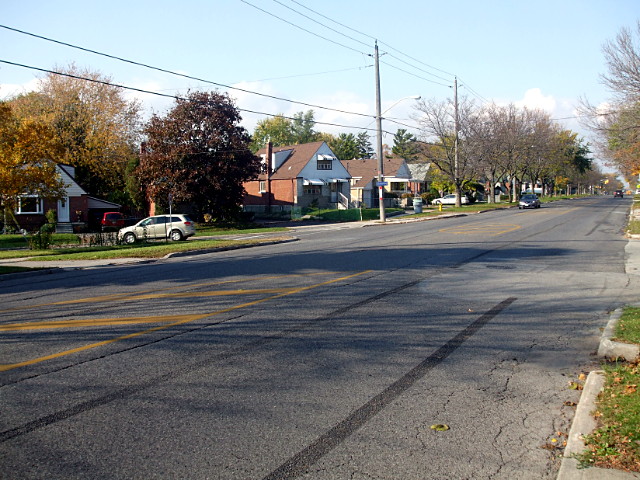
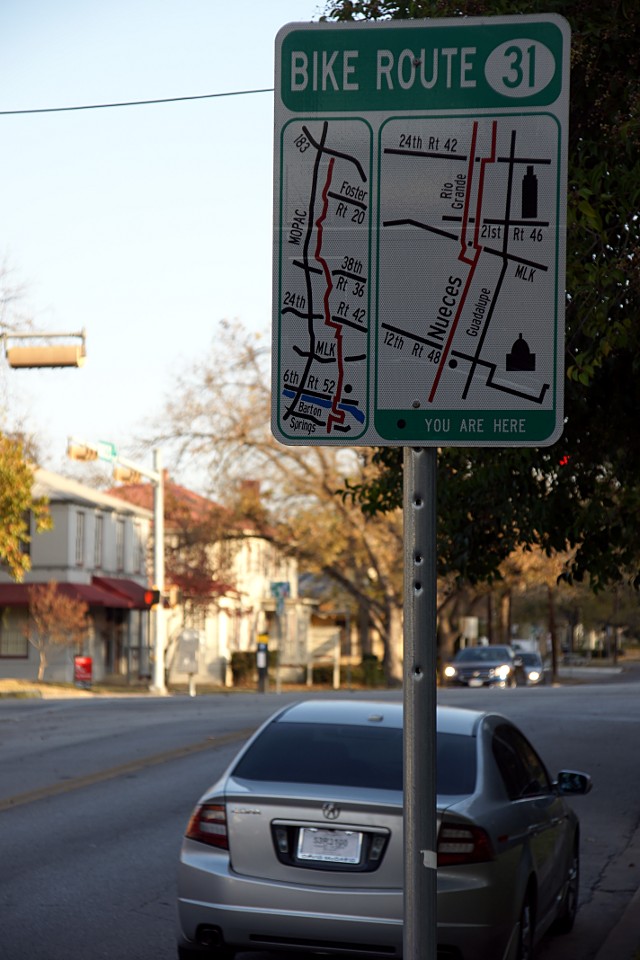
Yesterday afternoon, I was riding west along Summerhill Avenue, which forms part of bike route 41 through Rosedale and Moore Park. Traffic there is usually pretty calm and slow-paced, but shoppers and delivery trucks always seem to be jockeying for space in front of the Summerhill Market; so much so that a paid-duty police officer is frequently directing traffic in front of the store.
So I was riding along and could see two car drivers getting ready to pull out of their street parking spaces and directly into my path. One driver had the good sense to wait, but the other didn’t and just pulled into the traffic lane directly in front of me. I’d been anticipating the boneheaded move, so I was already in position to avoid the car if necessary, but it’s still pretty annoying to be either unseen or ignored in broad daylight. To cap the annoyance, after the driver cut me off and then slowed down in front of me, he held his hand up to thank me for letting him in. I started swearing at him under my breath. “Don’t wave at me, jerk. I didn’t let you in, I just avoided being hit. There’s a difference you know.”
And then for the first time ever in my many years of riding in the city, something almost perfect happened: the paid-duty officer at the Summerhill Market flagged the driver down and gave him a lecture. I couldn’t hear the driver’s protestations from my spot behind the car, but the officer’s half of the conversation went something like this:
You know you almost hit that cyclist, right?
[...]
It’s not his fault. He’s just riding along the street.
[...]
It’s on you to look for traffic before you pull out of your parking spot. It’s dangerous.
[...]
You have to be more careful. You could kill someone if you don’t look.
The officer eventually waved the driver on and I thanked him as I rode past, feeling quite a bit better than I had 30 seconds earlier. Overall, not a bad start to my ride.
What would have made the moment perfect instead of merely almost perfect? If the officer had pulled out a ticket book and given the driver a summons under the Highway Traffic Act, I would have had time to pull out my camera and take pictures. Oh well. It still made my day to have someone other than me lecture a driver for cutting me off.

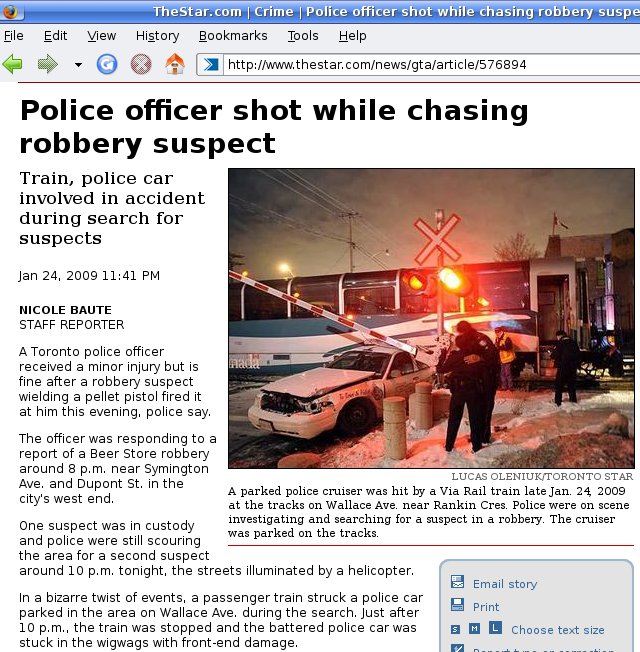
We all know that just like many other drivers, some police officers regularly park in bike lanes and other no-stopping zones. But the picture and an almost throwaway aside in this story from the Star illustrate that some officers don’t just have a rather liberal interpretation of the proper use of bike lanes, but they also seem a little confused about who has the right of way on those little ribbons of steel that crisscross the city. Surely even the most hubristic officer should realize that parking in the train lane is a losing proposition.
Also, top marks to the Star for using the fine phrase “stuck in the wigwags.” Although the term “wigwag” (yes, I had to look it up) is not technically applicable to the drop-down barrier that the cruiser is stuck in, I’m still filing it away at the very top of my “gotta-say-it-myself-someday” notebook.

I’ve long thought that there must be some provincial regulation requiring municipalities to install pedestrian signals whenever they reconstruct a signalized intersection. I’m all for the idea, but implementations sometimes trend toward the bizarre.
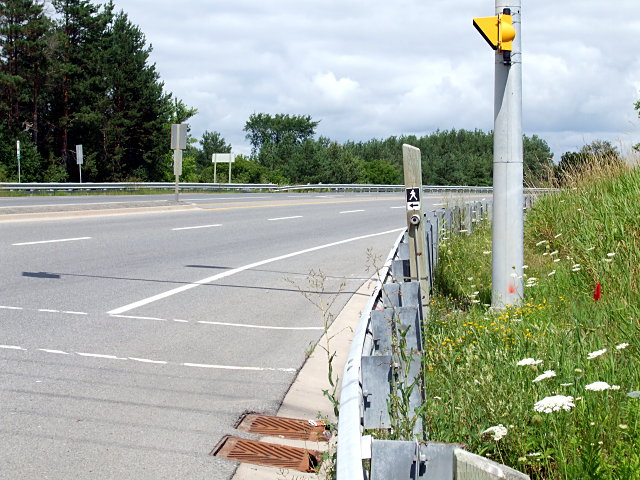
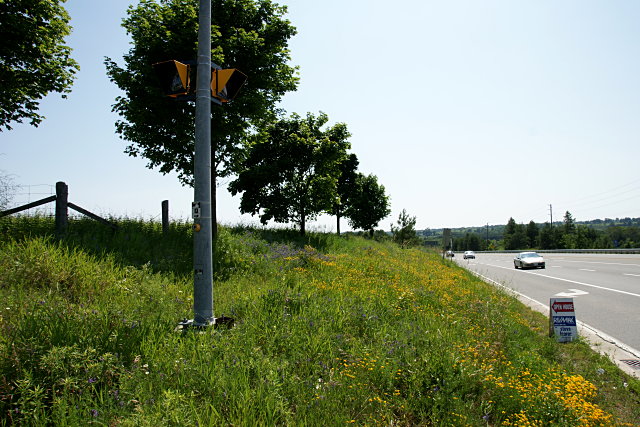
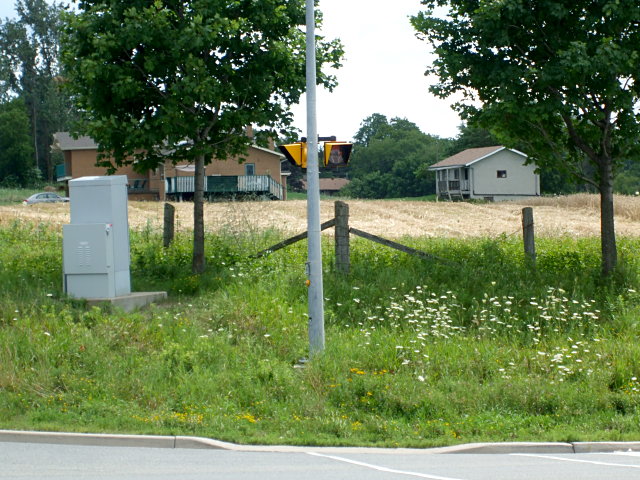
Take, for example, the intersection of Highway 7 and Westney Road in rural Pickering. It’s near the hamlet of Greenwood, with Valley View Public School just down the street and the Pickering Museum a country block away, but I highly doubt that more than a couple of pedestrians grace the intersection on the busiest of days. There are no sidewalks anywhere around here. Yet pedestrian signals and their activation buttons stand guard over each corner of the intersection, just waiting to be pressed by the hapless soul who finds himself lost here. So far so good. But when you look closer, you realize that with no sidewalks and corrugated beam barriers sheltering the buttons at three corners, the only way to activate them is to stand on the road. On the fourth corner, pedestrians have to climb a small weedy hill to press the button:

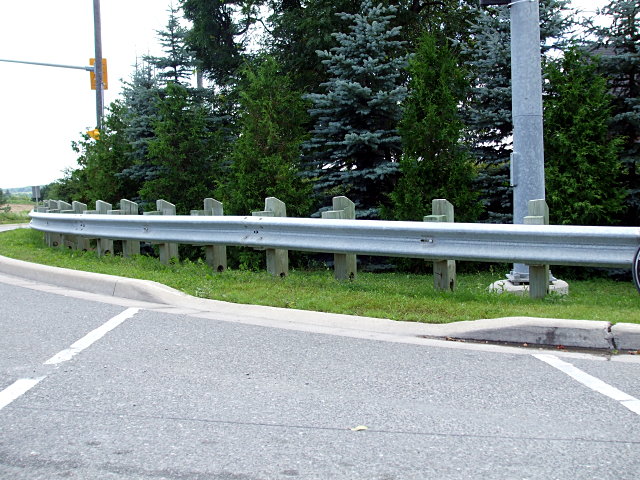
But even better than the activation buttons are the curb cuts, dutifully guiding people in wheelchairs and with baby strollers into the guardrails and onto non-existent sidewalks:


The whole thing smacks of some bureaucrat following the letter, but not the spirit, of the law.

Driving down the DVP a couple of weeks ago, I noticed an old roadway cutting through the brush just north of York Mills Road. I had a pretty good idea of what it was, but a quick look at Google Maps confirmed my suspicion: it was an abandoned on-ramp to the southbound Don Valley Parkway from westbound York Mills Road. The current DVP ramps at York Mills were reconfigured during construction to the overpass beginning in 2005. The northwestern loop of the cloverleaf was removed entirely. Or was it?

I went back by bike last weekend (the same ride where I blew out a tire) to investigate and was quite surprised by what I found. Not only was virtually the entire ramp still intact, but there had been no attempt to restrict access to it. I was expecting to see the traditional Toronto chain-link fence surrounding the road, but all I had to do was ride up a little hill before I was greeted by the remnants of the ramp in all its glory. I’m not saying that there should be a fence, just that I was expecting one. Toronto officialdom is so paranoid about putting fences and warning signs around everything more challenging than a sidewalk that I never imagined for a second that it wouldn’t be all locked up.
Although the subsequent landscaping at York Mills Road put the ramp’s remnants out of sight, the bulk of the road still sits behind the embankment, where it’s being slowly consumed by encroaching weeds. The posts that held up corrugated beam safety barriers around the perimeter of the ramp were cut down to the ground and a stone-lined drainage ditch has been dug across the roadway, but the ramp is otherwise intact to within a few metres of the highway.
Although you’re never farther than 100 metres from either York Mills or the DVP, the curving tree-lined ramp quickly isolates you from both. Even with the sound of traffic in the background, it’s surprisingly relaxing.
The current Google Maps image of the area, probably taken in 2005 or 2006, clearly shows an excavator perched at the very bottom of the ramp, presumably preparing to rip up the 50 metres or so of the roadway that was removed.
At some point, the now-unused land here will probably be sold off for—what else?—condos, and another little piece of Toronto infrastructure will disappear completely. In the meantime, this hidden corner of the city is being rezoned by the local flora.
A version of this post originally appeared on Torontoist.
Now that I’ve finally ridden the Ride for Heart, I have a few suggestions for improving the experience, getting more people involved, and making it safer:
- Separate it into two events: one race and one pleasure ride. It’s obvious that a lot of speed demons enjoy the opportunity to race along the DVP, but they really shouldn’t be mingling with riders who are just out for a leisurely Sunday pedal. With the racers leading the charge out of the starting chute at 6:45 a.m., it wouldn’t be a problem except that the 75 km course loops back on itself at the top, which puts the speedy peloton in conflict with much slower riders for at least a quarter of their ride. At the very least, the racers should start an hour earlier than other riders so that the two groups don’t conflict. Another option is to run the event over a whole weekend: multiple races on Saturday, pleasure ride on Sunday. I’m sure that racers would appreciate this just as much as the rest of us.
- Push back the start time. I mean, really, who wants to wake up at 5 a.m. on a Sunday morning to go for a bike ride? More importantly, how many more familes would participate if the latest start time got pushed back from 9 o’clock in the morning to 1 or 2 o’clock in the afternoon? I know, inconvenience to drivers, blah, blah, blah. Spare me. This could tie into my previous suggestion: have races in the morning, leisure in the afternoon.
- Let people start from somewhere other than Exhibition Place. What’s the point of forcing someone who lives in North York to drive down to the waterfront, ride up to North York and back to the waterfront, and then drive back up to North York? Wouldn’t it be better if they could just ride over to the York Mills exit and get on the DVP from there? I saw riders getting on and off at virtually every ramp along the highway, so people are already doing this anyway. And they’re probably not registering to participate, either. It’s not a problem for me to ride down to the Ex, but it would be a lot easier (and fun!) for me to use either the Don Mills or Bayview on-ramps.
- Ditch the set course and just let people ride wherever they want. As far as I could tell, the course isn’t really enforced anyway. A fast rider could probably have done the York Mills–Bayview loop several times before time ran out, and someone who signed up for the 25 km ride could have done the full 75 km without being stopped. Indeed, for all the checking I saw, anyone could have started any route at any time. For maximum effectiveness, tie this in with the previous item: let riders get on the highway wherever they want, ride wherever they want, and get off wherever they want. Riders should pay a set access fee at whatever ramp they use to access the Parkway and that should allow them to go anywhere.
- Do it more often. Why just one early morning in the spring? How about every Sunday through the summer? With different charities running it each weekend? Five bucks gets you on the DVP and Gardiner between 7 a.m. and 7 p.m. (with on and off privileges at any exit) every Sunday for three months. I know, inconvenience to drivers, blah, blah, blah. Suck it up.
All of these suggestions would get more people on the road and probably raise more money. If these changes were made, I’d anticipate a minimum of 150,000 cyclists taking part. Just set up tables at each entrance, sell wristbands for $5–$10 and let people cruise at will.

After years of stubbornly refusing to wake up at 5 a.m. on a Sunday morning, I finally made it out to the Ride for Heart today. I thought it went fairly smoothly. I got to Exhibition Place just before 6:30 a.m. and settled into the starting chute for the 75 km ride at 6:32, about 15 minutes before the scheduled start. Quite a number of late arrivals rode along the adjacent sidewalk or lawn to get to the front instead of taking up their spots at the end of the line. Nice.
Although well within my range once I’m in cycling shape for the year, today’s total ride length of 98 km (including 23 km round-trip from home to the starting/finish line) over four and a half hours was two hours and 40 km longer than I’d gone since October. You betcha I’m sore. But it’s a good sore. And next weekend, I’ll ride farther.
Right at the front of the starting chute was a large group of riders who raced the entire 75 km. I don’t know who won, but I do know that the peloton (and its police escort) lapped me around the 40 km mark.
I was surprised by the number of people who got flat tires or were injured along the ride. I stopped to ask at least a dozen people with flats if they needed assistance (one of the moral duties of those who carry tool kits), but they all waved me on. Injuries along the route included a guy who was screaming in pain as he was hoisted onto an ambulance stretcher, a woman with a nasty gash on her head, several other people receiving roadside attention from paramedics, and at least two other ambulance sightings. All but one of the injuries I saw were on straight sections of the track, and the course wasn’t really that crowded after the start. Another guy was walking with his bike tilted up on the rear wheel, the badly twisted front wheel hanging uselessly in the air.
While I was pondering the causes of all the accidents, a woman passed me on the right, looked back at me as her rear wheel slowly drew even with my front, said, “Passing on the left,” and then cut right into my wheel. I would almost certainly have joined the injured if I hadn’t braked in time or if someone had been behind me. Just goes to show you that idiots drive all kinds of vehicles.
It was good to finally get out to this event, although it felt a bit like Friday’s Big Critical Mass Adventure took the wind out of some of the novelty.

I stumbled across the Zig Zag-by-the-Lake bike races in Marilyn Bell Park on Sunday afternoon. The riders all looked quite relaxed as they zipped around the course at what seemed to be about twice my best speed. Consider this a sneak preview of next month’s Toronto Criterium.
More pictures below the fold.
Read more »

With the TTC strike on (and possibly over by tomorrow), I thought I’d get out and enjoy the promised bike lanes on Queen’s Quay. I couldn’t find them at first, but then realized that in all its wisdom, the City had put them smack in the middle of the road. And what wonderful bike lanes they are: nice and wide, smoothly paved, and grade separated. I think this temporary installation is even better than the original Quay to the City almost two years ago. I could live without all the streetcar tracks cluttering the lane, though. What’s up with that?
I was surprised that the new bike lane was so deserted on such a nice day. I heartily encourage more cyclists to take advantage of these lanes while they last.
Section 148-7 of the Ontario Highway Traffic Act offers up this requirement:
Where one vehicle is met or overtaken by another, if by reason of the weight of the load on either of the vehicles so meeting or on the vehicle so overtaken the driver finds it impracticable to turn out, he or she shall immediately stop, and, if necessary for the safety of the other vehicle and if required so to do, he or she shall assist the person in charge thereof to pass without damage.
I cite this as proof that drivers people (and the law) used to be civilized. I’m sure this clause had application at some point in our distant past, but it seems quaint and head-pattingly naive to suggest that someone today would get out of his car and help another driver to pass him. Unless flipping the bird and shouting out the window could be considered “assistance” in this context.

The appearance of yet another traffic camera in the city is hardly remarkable. But it is a little unusual when that camera is watching traffic on the Don River just south of Pottery Road. Although it was used extensively for transportation in its almost-forgotten past, the Don is not exactly known for its 21st-century traffic jams and accidents.
The camera, installed about a year ago beside a gauge house that monitors river levels and flow, is actually used by Toronto and Region Conservation (TRCA) to provide visual correlation of data from other instruments. While a gauge may indicate only that river flow is lower than normal, the camera can see an ice dam. This camera is currently the only one in TRCA’s stable, but they’re trying to identify suitable locations for more.
Not only can TRCA monitor the Don—indeed, all of the rivers under its purview—from its Downsview offices, but thanks to a new public web site (login with username “public” and password “public”), you can play Conservation Authority from the comfort of your parents’ basement. For more than a dozen locations, you can view real-time results from monitoring gauges, or graph water level and flow trends over time. There’s even a version of the data optimized for viewing on your Blackberry. With practice, you’ll be able to tell when the Bayview Extension is flooding or when your new bridge is in danger of being washed out. And yes, you can even see the current view from that camera pointed up the Don. What more could a budding environmentalist, river geek, or curious writer ask for? The site is still under active development and will eventually have more features and display data from more gauge stations.
Most of this is probably not terribly exciting to the majority of people, but it’s notable as one of the few online government projects that gives the public access to detailed real-time information rather than just watered-down summaries after the fact. Most effort of this variety seems to be directed towards car drivers, showing not only camera views, but also providing analysis of current driving speeds. It’s a little refreshing to see agencies applying some of the same principles and technology to other uses.
Map from trcagauging.ca. Thanks to TRCA’s Don Haley for his assistance. A version of this article originally appeared on Torontoist.