Supermarket finds: Hurry up and wait

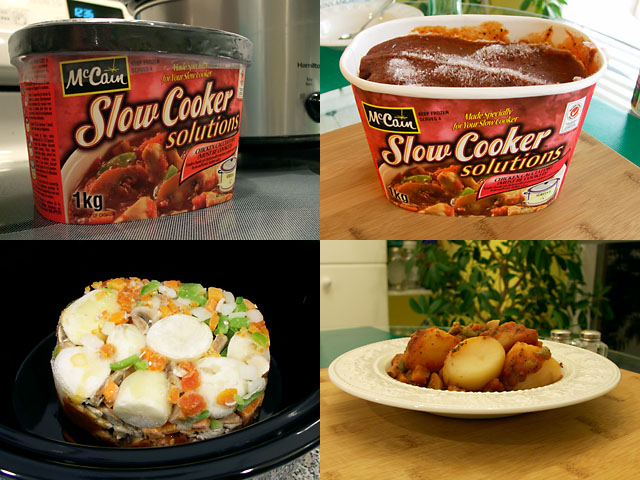
McCain Slow Cooker Solutions in four steps

The strangest convenience food I’ve seen since aerosol cheese is McCain‘s latest entry in the frozen foods aisle, Slow Cooker Solutions. The selling point of most convenience foods is how quickly they can be prepared. As microwave ovens became popular in the 1980s, we gradually lost the ability to wait half an hour for dinner. Food preparation broke the 10-minute, 5-minute, and 2-minute barriers. And still it wasn’t fast enough. Only recently have we finally gotten foods ready in a mere five seconds, missing by a mere five seconds our collective dream of having food in our mouths the very instant we think about it.

And then along comes McCain, boasting that its new Slow Cooker Solutions require 8-10 hours for preparation. I would have loved to be a fly on the wall for that pitch meeting.

Those of us with slow cookers are familiar with this drill: cut up and measure the ingredients, dump it all in the pot, wait for 6 hours or so, then spoon out the deliciousness. I’ve got to admit that McCain has some huge cojones trying to convince anyone with a slow cooker that it could be any easier. So naturally, I couldn’t help but try out a Slow Cooker Solution. I’ll add that I bought this in mid-November, long before the annoying commercials started on TV.

The verdict? It’s surprisingly edible. I wouldn’t serve it to guests, but it’s better than most frozen food. The Chicken Cacciatore I tried for this experiment is notable for having only real ingredients on the label; none of the three varieties has any flavour, quite a rarity in the world of frozen convenience food.

Yet I doubt I’d buy it again. If I’m thinking far enough ahead that I’m using the slow cooker, I don’t really care if my preparation time is cut by five minutes. I almost never eat frozen convenience foods, and Slow Cooker Solutions just aren’t good or convenient enough to make me start.

Holding the bag

It seems a little weird that China can ban plastic shopping bags, but Ontario can’t. I’m just saying.

We’ve been using reusable shopping bags at the grocery store for about four years now, and I can’t say that I miss all of the extra plastic. Risa has taken it to the next level, almost always toting a bag or two for all of her other shopping. She’ll also unpackage her purchases in the store, leaving retailers to deal with their own detritus. It’s a small thing, but maybe they’d get the message if enough people did it.

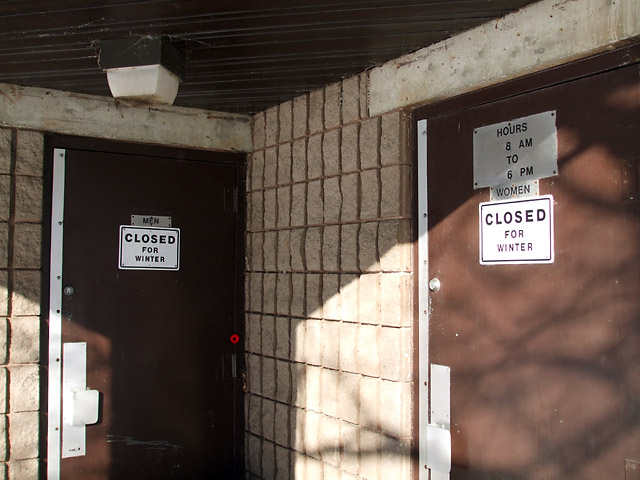
Closed for the winter

Closed for the winter

I’d been planning to do a mini photo essay about all of the “closed for the winter” signs that the City slaps up on virtually everything that doesn’t cater to cars, but recently discovered that Now did a pretty good job of it three years ago. Sadly, Toronto officialdom’s aversion to winter has probably gotten worse since then.

I see faces #1

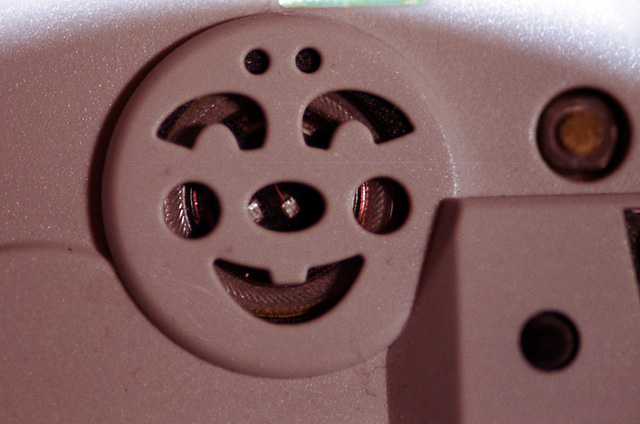
Nokia 5190

I see faces. Some are deliberate constructions for all to see; some are accidental, the result of happenstance or coincidental placement of everyday items. Yet others are semi-hidden, perhaps as sly easter eggs created by playful designers. Today’s face belongs in the final category. You’re looking at the earpiece of an old Nokia 5190 cell phone with the faceplate removed. You can see the face in context in this picture at Wikipedia. I took this picture way back in 1999, knowing that I should document the discovery for future use someday. Today is that day.

Something about seeing a face—whether deliberate or accidental—in an unexpected place always makes me smile. You’ve got to know that whoever designed the Nokia 5190’s inner case smiled too as these started rolling off the production line.

Life without flavour

I read a curious label at work a few months ago, and it got me thinking: What would it be like to restrict myself to food without flavour? I’m not talking about eating nothing but watery gruel and rice cakes, but about eliminating from my diet any foods that list natural or artificial flavour as an ingredient.

The label that got me thinking was on a package of Carnation Instant Hot Chocolate, where “cocoa” came later on the list of ingredients list than two kinds of sugar (the first and second ingredients), hydrogenated oil, and modified milk ingredients, preceding only such minor constituents as cellulose gum, salt, and diglycerides. And, of course, artificial flavour. I had two minor epiphanies at that moment: first, that you could probably remove the cocoa entirely from the mix and not really notice any difference in the final product. It’s almost as if the cocoa is there only so that they can call the final product Hot Chocolate and not Hot Brown Powder Vaguely Resembling Something You Enjoyed As A Child.

The second epiphany was that “flavour” of any kind on an ingredient list is the surest sign of food that’s been overly processed. After all, I can’t remember the last time I reached for the flavour shaker on the dining room table to lend a bit of bite to a bland dish. In our kitchen, adding or changing flavour is accomplished by mixing and balancing actual ingredients, not by opening a can of molecular soup that captures the essence of a flavour without any of the bother of actual ingredients or preparation.

The web page for Carnation Instant Hot Chocolate claims that it’s “a good source of calcium when prepared with 6 oz (175 ml) of milk.” Yes, I suppose that’s true in the strictest sense. But by that measure, Iocane powder, dirt, birch bark, and air are also good sources of calcium when prepared with milk. Or, you could just drink the milk (and hold the modified milk ingredients).

So for several months, I’ve been reading ingredient lists of virtually every processed food I eat, with a soft target of January in my mind for the beginning of my culinary adventure.

I think I eat a healthier diet than the average North American. Like anyone, I overindulge in some things and have my vices, but I eat more fresh fruit and vegetables than most. I eat meat, but far less than I used to. Butter is virtually gone from my dinner plate. We prepare dinner fresh at home 5-6 times a week, I make lunch every day rather than popping out to the local Burger King, and I don’t even put sugar in my tea any more.

So as of today, I’m going to eliminate as much flavour as possible from my food intake. The ultimate goal is to get rid of it all over the coming weeks. I already have a good idea of what’s going to have to go (yes, this includes Grapples) and I’ll be posting updates on my progress every once in a while.

Supermarket finds: Grapples

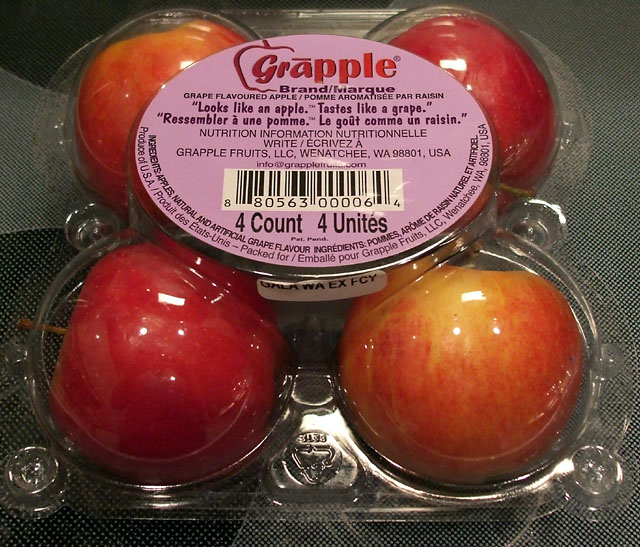
Grapples

“Looks like an apple. Tastes like a grape.” Call me a dork (Risa certainly did when I brought these home), but that’s the kind of promise that I just can’t resist. So despite the over-packaging, I picked up a pack of Grapples at the supermarket a few days ago. No, these are not some genetic freak of nature; they’re real apples that have been infused with grape flavour through a “patent pending process.”

Not content to keep this discovery to myself, I unleashed these on some unwary testers on Saturday night. The general verdict, aside from shock and horror at such an abomination on the dessert table, was that the Grapples were underwhelming. Instead of tasting like grapes, they taste pretty much like apples. There’s a definite, um, aroma to them, but they smell more like grape Kool-Aid than actual grapes. In other words, they smell completely artificial and only vaguely grapish.

Oh well. The quest for the perfect apple/grape abomination continues. Or not.

The world has changed. You can too.

I just saw an interesting WWF-Canada commercial on TV. The spot is a series of vignettes of activities that have been considered normal at some point in the past: unrestrained kids jumping around and playing in a convertible moving down the highway, a doctor lighting a cigarette for a pregnant woman, a man patting his secretary’s behind after she brings a drink to his desk, and so on. It ends with the message, “The world has changed,” and a shot of a man in a suit carrying his bicycle out of his townhouse and starting his ride to work. “You can too.”Brilliant. This is exactly the kind of message needed to counter the head-in-the-sand viewpoints of people like Case “people won’t get out of their cars” Ootes and Roger “if you’ve got $1.8 million to spend I think you can find something better to spend it on than bike racks” Anderson. A few of us already think that those two should be on display at the ROM.The TV spot goes with a print campaign that echoes the “society has changed” idea and features the tagline, “Not long from now, the way we’ve been treating the planet will seem just as wrong.” We can only hope.

No parking

No parking

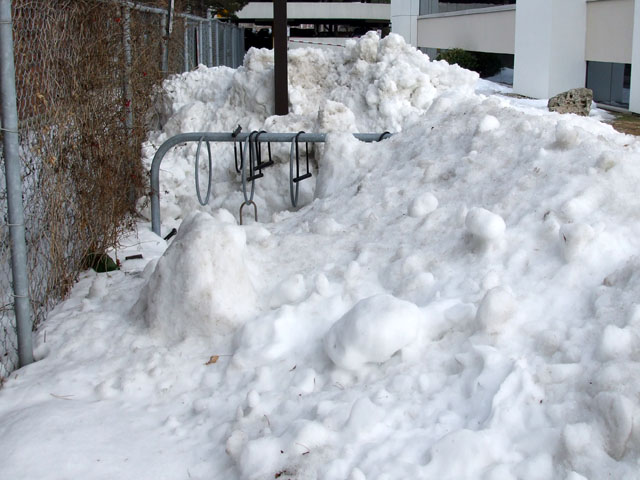
Hmm, good thing there’s another bike rack around the back of the building, because it doesn’t look like I’ll be using this one for a while. Mind you, this is the one that’s in full view of the security cameras. Figures.

Take a (snow) hike

Really big shoe

What’s the most fun you can have in the days following a big snowstorm?

Unlike many winter sports, snowshoeing is relatively inexpensive and requires little in the way of specialized equipment. Other than the snowshoes themselves—a decent pair costs less than a good pair of skates—you need only some warm layers of clothing, a sense of adventure, and as much time as your legs can stand.

It really couldn’t be any easier to learn, either: just strap on your snowshoes and start walking your way to an energizing workout. Or take a slower pace and explore corners of the park where you wouldn’t normally go.

With terrain varying from wide open fields to challenging forested hiking trails, Toronto’s Rouge, Don, and Humber Valleys (not to mention dozens of smaller ravines and parks around the city) offer prime snowshoeing opportunities without requiring travel outside the city. If you live or work close to a suitable park, snowshoeing is hard to beat as a lunchtime fitness activity. It’s mind-clearing and relaxing, and leaves you ready to tackle whatever boredom awaits you at the office in the afternoon.

The only real barrier to snowshoeing in the city is Toronto’s wimpy weather: with frequent thaw cycles throughout the winter, ideal snowshoeing conditions usually only last for a few days after a big storm before all the snow starts melting away into slush.

If you feel the need to go farther afield and escape the city, check out the offerings of a local organization like the Toronto Bruce Trail Club or Outing Club of East York for group snowshoe hikes through conservation areas or resorts outside the city. From the base of frozen Webster’s Falls to the top of Rattlesnake Point, there’s no shortage of snowshoeing challenges in and around the GTA. Sites outside Toronto usually hang onto their snow longer than we do in the city, but you should always check conditions at your destination before heading out.

What if you don’t have snowshoes and don’t want to buy them? You can always rent from the MEC or one of many winter resorts in southern Ontario. For those inclined to frugality or craftiness, there are do-it-yourself instructions available online for several different varieties of snowshoes. You have no excuse not to try it.

So what’s the most fun you can have in the days following a big snowstorm? Tobogganing, of course. Snowshoeing doesn’t even come close, but it’s still fun in its own way.

A version of this article originally appeared on Torontoist.