Winter commuting part 2

It didn’t take long: I installed studded tires on my bike on Tuesday, a mere two days after wondering about their value. My regular route was quite icy thanks to Tuesday’s freezing rain and I decided that I’d accept any drawbacks to studded tires in order to get the extra margin of safety.

After quickly considering a couple of options, I ended up getting a pair of Schwalbe Snow Studs from the MEC. They seem to be a good compromise for commuting in a Toronto winter because they ride almost like regular tires on dry pavement, and you can just lower the tire pressure a bit to get more spike->road contact on those messy days. They came in very handy on Thursday’s sloppy ride home, when I could definitely feel the extra grip as I turned onto a couple of side streets for the last leg of my ride. As an additional benefit, they have reflective stripes on the sidewalls, contributing to my goal of being as noticeable to motorists as possible. The only real trick is not to get overconfident; in any kind of marginal conditions, it’s pretty easy to get into trouble quickly.

There’s just one problem with this: my quest for safety has turned me into a law-breaker. According to my reading of the regulations, it’s just as illegal to use studded tires on a bicycle in Ontario as it is to use them on a car. There’s some question about the reasoning behind Ontario’s ban on studded tires, and the rule makes even less sense when applied to bikes. Surely a bike, even one with studded tires, causes less road damage than does a car weighing a hundred times as much. I’ve been thinking of writing a letter to my MPP—who happens to be the NDP’s Environment Critic—asking him to push for an exemption for bikes.

Three weeks

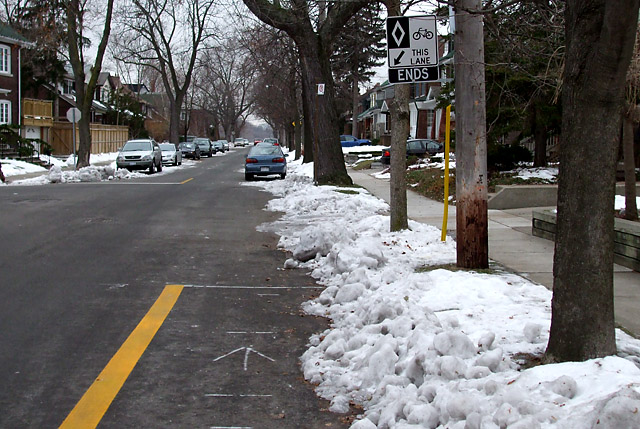
End of the lane

Three weeks. That’s how long it’s been since crews started work on the short (about 70 metres) contra-flow bike lane on Chester Hill Road between Cambridge and Broadview Avenues. I’ve been sitting on this post since they started work on the lane around November 20. Instead of celebrating its completion a day or two later, I’m still waiting.

Still waiting for the bike laneTo date, the 70 metres of asphalt is only half painted: the solid yellow line separating the lane from oncoming traffic is done, but the diamond markings are still missing. In their place for about a third of the lane are diagonal stripes that prohibit traffic (including bikes) from using that portion of the road. Those were put in earlier this year when the City repainted the road to make left- and right-turn lanes.

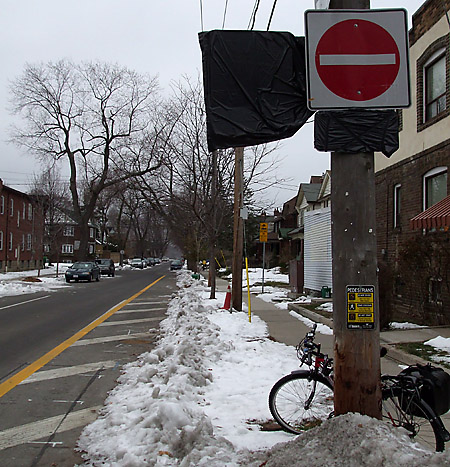
Only one bike lane sign is up (ironically, the one that proclaims the end of the lane) so far. Another is still covered in plastic wrap, and at least two more signs are still missing: one “bicycles excepted” sign allowing bikes to turn onto the street from Broadview despite the right-turn prohibition, and a stop sign for bikes at Cambridge (which, I’m quite sure, all cyclists will obey).

The signs and paint merely formalize what has long been an informal and well-used route to the Bloor Viaduct for cyclists wishing to avoid the traffic on Broadview. Chester Hill is one-way for only a single very short block, presumably for the express purpose of preventing cars from taking this very same shortcut.

I’m not faulting Transportation Services for the snow and rain we’ve seen since the day after they started work on the lane, and I realize they can’t do much until the snow is gone. But it’s unacceptable that virtually all of the bike lane work in the city was left to the last three months of the year.

When Adrian Heaps made his ill-advised promise of 30 km of lanes this year, many cyclists were skeptical. Even so, the year’s piddly effort of 5 km or so is, in a word, pathetic. I don’t think anyone expected that the city could do any worse than the glacial pace of installations during the last couple of years, yet they managed handily. So now Heaps is promising 50 km for next year? Pardon my skepticism, but once bitten…

The astounding thing is that Council still talks about finishing the Bikeway Network by 2012. They do realize that that’s only 5 more working years, right? They do realize that since the inception of the Bike Plan, bike lanes are being created at a quarter of the necessary pace, and that even that pace has been slowing down in recent years, right? They do realize that they have no credibility on this matter any more, right? They do realize that their lip service is the reason that groups like OURS are thriving this year, right?

Council’s plan to kickstart the creation of 50 km of lanes next year by picking all the low-hanging fruit sounds good, but it means that they’re leaving the more difficult 400 km or so for the final four years. If they can only do 50 km of “easily-approved” lanes in a single year, what are the odds that they’d be able to do 100 km of “difficult” lanes each year for the four years after that? I believe the correct answer would be “Nil.”

I suppose that the Chester Hill bike lane is a perfect metaphor for the bike plan: a small but important piece of a larger puzzle that seems hopelessly stalled after a promising start. Well, there’s always next year.

Rink in the raw

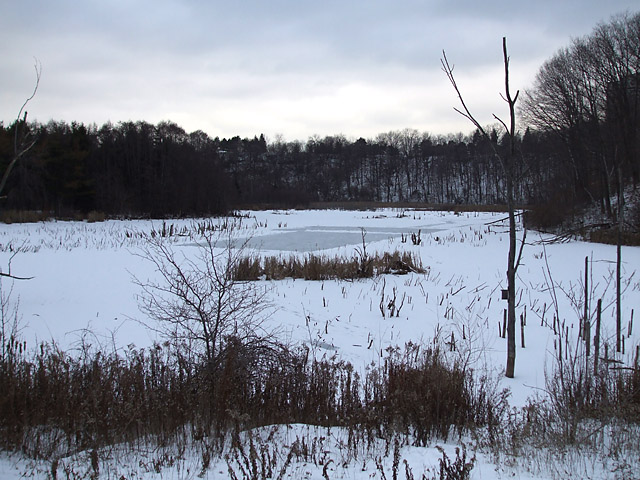
Natural ice rink in E.T. Seton Park

There’s something about the sight of a natural skating rink that warms the heart. I noticed on Monday that someone had cleared a good-sized rink on the marsh in E.T. Seton Park. The marsh was pretty completely frozen over last week and I wondered how suitable it would be for skating. I guess someone found out.

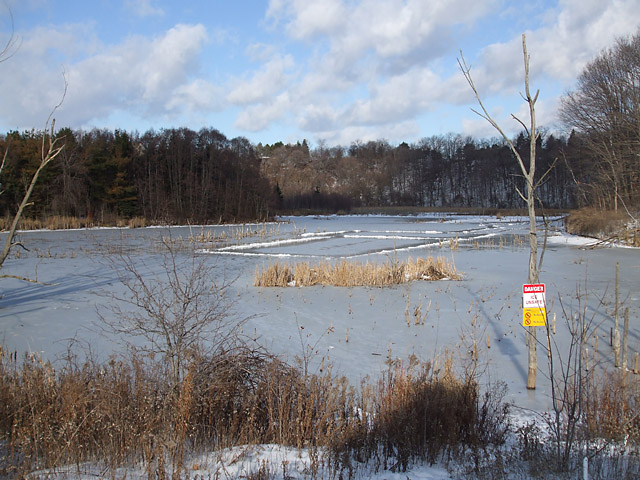
Natural ice rink in E.T. Seton Park, gone until the next freeze

Of course, by Wednesday, the party poopers at the City had put up new “Ice Unsafe” and “No Skating” signs and melted all of the ice. Those fun-hating bastages. I don’t mind the signs so much, but they could have left the rink intact.

Despite the relative deep freeze of the last couple of weeks, I think it was still a little early to be heading out on natural ice. The ice looked solid even on Monday, but I wasn’t going anywhere near it. Call me paranoid, but I can wait until a proper January freeze.

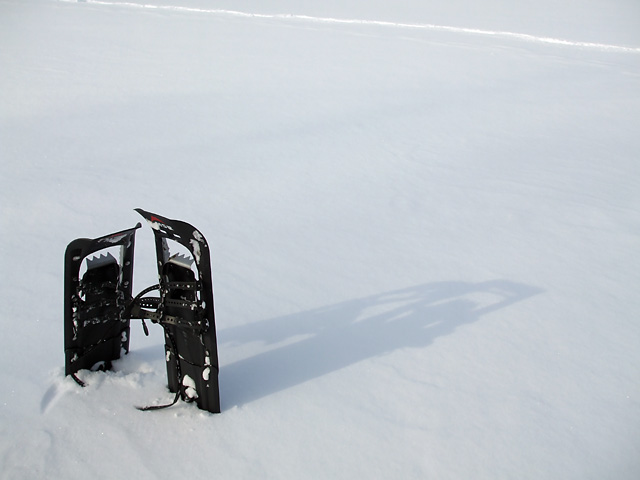
The “No Skating” signs include a hand-lettered reference to Chapter 608 of the Toronto Municipal Code, section 21B of which states that, “No person shall access or skate on a natural ice surface in a park where it is posted to prohibit it.” Are there any natural ice surfaces in Toronto that don’t get “No Skating” signs posted every winter? Last I heard, even Grenadier Pond gets this treatment. Signs also line the banks of the Don River, and I can’t remember ever seeing that chemical soup frozen over. I did snowshoe across Taylor Creek once a few years ago, but only because I knew the river was about three inches deep below the ice.

Winter commuting part 1

In the past, I’ve always put my bike away for the season at the first snowfall and brought it out again when the streets and paths are clear of snow in March or April. It’s not that I couldn’t ride in the winter, it’s that I didn’t want to expose my bike to the destructive power of road salt. Plus, my rear brake or derailleur cable always seems to snap around mid-December, requiring about two months to replace it. Or so I always told myself. It seems that the first snowfall has always provided a good excuse to put the bike on the repair stand where I could visit it every couple of weeks to make all those little adjustments and repairs that I’d been putting off all year long.

But a couple of things have changed this year. First and foremost, I finally have a beater that I can sacrifice to the slush and ice without crying too much in the spring. Second, this is my first year commuting by bike. It’s easy enough to put the bike away for a couple of months when you’re a recreational rider and can spend the winter hiking or snowshoeing instead, but it’s a whole other level of hurt when putting the bike away means standing on a crowded bus twice a day with 75 of your smelliest, grumpiest acquaintances.

So as the snow started falling a month ahead of schedule a couple of weeks ago, I’ve tried to keep riding as much as possible. We haven’t had a real dumping yet, so it’s been a gradual introduction to riding in conditions that I’d normally avoid. I’ve made a few observations that won’t be news to anyone who normally commutes in the winter:

  • I need more lights and reflectors for the ride home. There’s just something about riding in poor weather that makes me want to be lit up like a Christmas tree. I usually have blinking lights front and back, reflective tape on my forks, one of those ubiquitous MEC cycling jackets, and an ankle strap. In the last couple of weeks, I’ve added a helmet light and extra reflectors. Starting tomorrow, I’ll be replacing my regular rear blinker with my oversized and much brighter rear blinker. In the next few days, I’ll be adding a bigger and brighter front light, some additional reflective tape on my pannier, and may get one of those reflective vests for good measure. Call me paranoid, but I’ve been less certain than usual that drivers actually notice me. It’s not just about riding at night, which I do all year long. What I really want is a helicopter following me all the way home with a 30-million candlepower searchlight trained on me.
  • For the most part, car and truck drivers give me more room. Granted, I don’t commute downtown or through the worst of high-speed suburbia, but I’ve noticed a huge difference in the patience of drivers. More of them seem to be more willing to wait behind me for a few seconds while I take the lane to get around a spot of ice or snow, and when they do pass, they’re more likely to move into the next lane entirely rather than try to squeeze past. We’ll see if this courtesy lasts into the new year.
  • Bike lanes are disasters. It’s almost like crews go out of their way not to plough them. On any other street, the ploughs get to within a few inches of the curb, but if there’s a bike lane, they’ll only go so far as exposing the solid white line, teasing you with what could have been. Given what I’ve heard from others, the city is completely unresponsive on this matter, coming up with excuse after excuse why bike lanes simply can’t be cleared. Yeah, and it would be impossible to announce stops on buses, too. I’m quite certain that I wouldn’t get any help on the matter from my councillor.
  • I will never, ever again throw snow onto the street when I’m clearing it from the sidewalk. I’ve always tried to avoid doing that anyway, but after riding through a few snow plumes from people’s driveways, it’s much clearer just how much of a hazard it is. I hereby apologize to any cyclists I’ve endangered in the past. It won’t happen again.
  • I’m still sitting on the fence about using studded tires. There have been days when I really would have appreciated the extra grip, but I’m not sure if it’s worth riding around on them the rest of the time.
  • Some coworkers think I’m off my rocker for riding in this weather. I think it just adds to my aura of mystery and intrigue in the office.

Overall, I’d say that riding in typical Toronto winter conditions really isn’t that difficult or daunting. The roads are generally clear a few hours after a snowfall. Unfortunately, the same certainly can’t be said of any bike lanes along the way. I had to take a couple of days off the bike this past week for reasons not related to the weather, but plan to be back on the saddle come Monday morning.

Old Don Mills Road

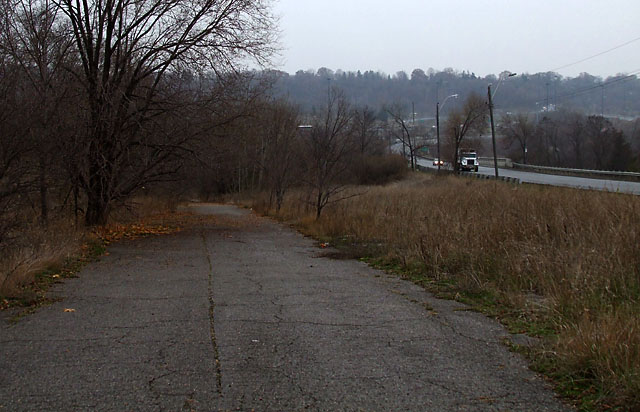
Old Don Mills Road

Most people wouldn’t associate Toronto with abandoned roads, but a few of them dot the city if you know where to look. One of the better examples is this surviving portion of old Don Mills Road as it climbs north out of the Don Valley. The current Don Mills Road is to the right in the picture above. The original road was realigned and widened in the 1950s to connect the new community of Don Mills to the north with the established community of East York to the south.

The old road was mostly eliminated south of Overlea Boulevard, but a short section about 200 metres long survives more or less intact, just out of view of the thousands of drivers hurrying past. It’s currently used by bicycle commuters and local residents as a shortcut into the Don Valley trail system. The trees and weeds encroach on the road a little bit more every year.

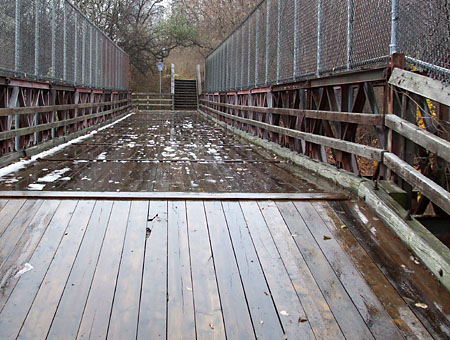
Bailey bridge in the Don ValleyDirectly south of here is the single-lane Bailey bridge that carried the road over the CN tracks for a time before being replaced by the modern overpass a few steps to the west. The bridge is still in use as part of the main pedestrian and cyclist route through the Don Valley. If you look closely, you can still make out the name of the manufacturer—England’s Appleby-Frodingham Steel Company—on some of the beams.

Continue south across the Bailey bridge and down the hill and you’ll come to another bridge that was part of the original road. Visible from the DVP near the Elevated Wetlands, the old concrete bridge still carries vehicular traffic over the East Don River to a small parking lot.

To find old Don Mills Road, walk south on the east side of Don Mills Road from Overlea Boulevard. After the sidewalk ends, follow the narrow dirt path until it curves to the left and takes you to the old roadway. From the south, walk up the stairs from the main park pathway at the northern end of the Bailey bridge.

A version of this article originally appeared on Torontoist.
Winter commuting essentials

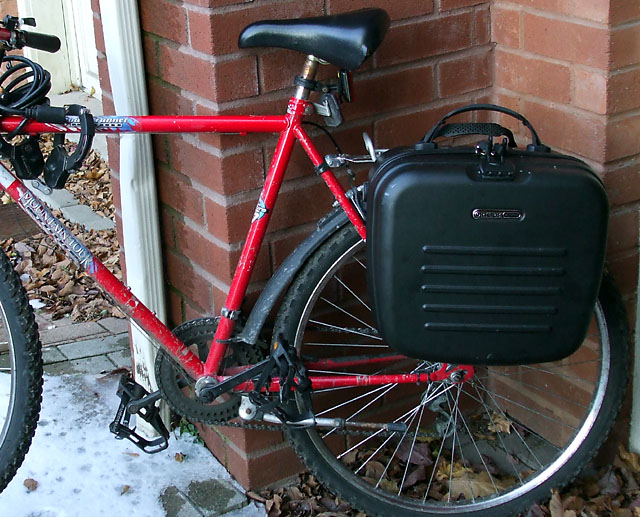
Waterproof Ortlieb TourBox pannier

A few recent discussions on other sites have covered the topic of essential gear for commuting by bike in the winter. They’ve covered the usual suspects of pants, jackets, footwear, lighting and tires, so I won’t duplicate that here. But one thing has been conspicuously missing from all of the roundups: panniers. Specifically, waterproof panniers.

I’ve had a pair of water-resistant panniers for years and learned the hard way one rainy day that “water-resistant” really means “leaks like a sieve when you least want it to.” The same goes for my “snow-shedding” backpack. And my raincover-equipped daypack is a little too small to carry all of my commuting gear with me.

When I started carrying my new ultra-portable PC everywhere last month, I knew I’d need something rain- and snow-proof for transporting it on those wet and slushy days through the tail end of the year. It’s one thing if my lunch and work shirt get wet in an unexpected storm, but quite another if I have to empty the water out of my hard disk.

After looking at various alternatives, I ended up buying a pair of Ortlieb TourBox semi-rigid waterproof panniers. Velotique was clearing them out and I may have gotten the last two. Most of the other models that I looked at had drybag-style roll tops, and I’ve never had much confidence in my ability to cinch them down properly. In contrast to drybags, the TourBox looks like a small suitcase—inside and out—and closes with a waterproof zipper. It also features a combination lock (to prevent casual snooping, not theft) and the best quick-release shoulder strap system I’ve ever seen anywhere.

It seems that it’s rained (or snowed, or slushed) virtually every day since I bought my TourBoxen four weeks ago. Having been drenched from both rain and road spray, I can verify that they are absolutely waterproof. I don’t think I’d take one swimming with me, but the handle the worst that the city can throw at them.

My only real issue with them is that I wish they were just a little bit larger. Not much, just a couple of centimetres in each dimension. As it is, I can squeeze my rain/cold gear, commuting lights, fully-loaded man purse, change of clothes, and lunch bag into a single 19-litre TourBox, but there’s not much room left over for anything else. That said, the squarish shape and full-open zipper make loading easy and efficient, especially for hard or oddly-shaped items that don’t much like more traditionally-shaped panniers.

Related: You can make your own waterproof panniers out of cat litter buckets. I first saw something like these about five years ago, but wanted something a little more office-appropriate. Seeing the relatively inexpensive Bikebins in the Winter 2007/2008 MEC catalog got me started investigating waterproof panniers a couple of months ago, but they disappeared from the MEC’s website after a couple of weeks and aren’t in the stores. I’m not sure why.

Walking in a winter wonderland

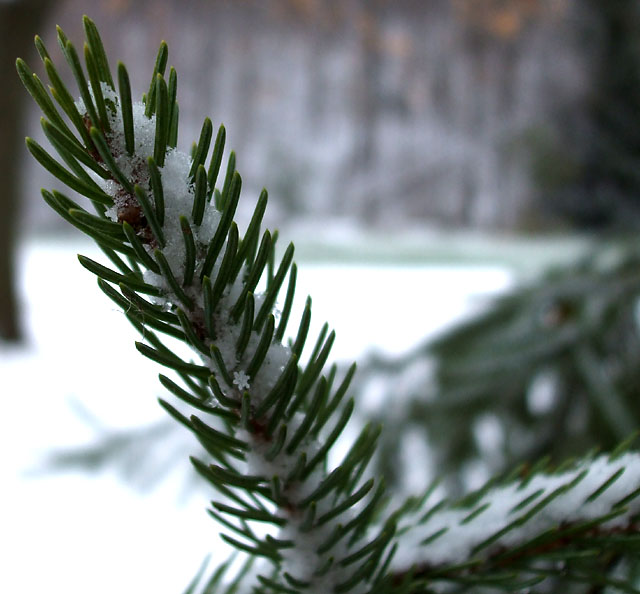
Snow-dusted pine tree

Ah, the first snowfall of the year. This is one of my favourite times to walk in the Don Valley. This stretch of E.T. Seton Park is normally quite well used, even during the constant rain of the last few weeks. But I only saw one other set of bootprints along the snow-covered path today, and a single lonely bicycle track heading south. There were more deer tracks (3) than car tire tracks (none) in the two parking lots I passed.

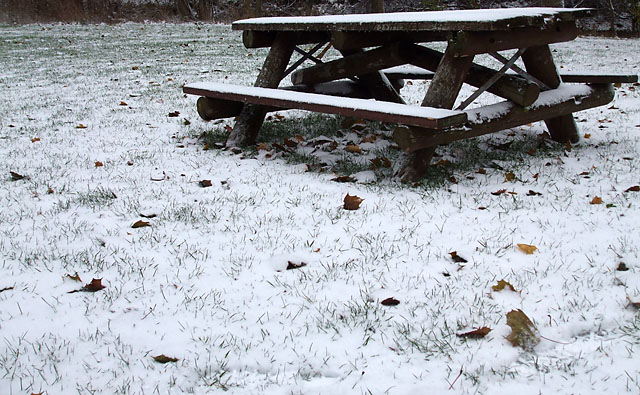
Snow-dusted picnic table

I usually take my daily lunchtime constitutional in this section of the park (those familiar with the area may have noticed that many of my posts originate in E.T. Seton Park and environs), which is quite well shielded from the worst of the weather that rages outside the valley walls, allowing a nice relaxing walk on all but the most blustery of days. The walking choices in this single area vary from a forested hiking trail to scenic trails around a marsh to a paved level path traversing the length of the park. I took the easy route today. Though I was never more than a couple of hundred metres away from the traffic and slush above, I couldn’t hear a sound other than the crunching of my boots in the fresh snow. That’s what winter’s all about.

Into the wild

2007-11-20-tree-planting-0595f.jpg

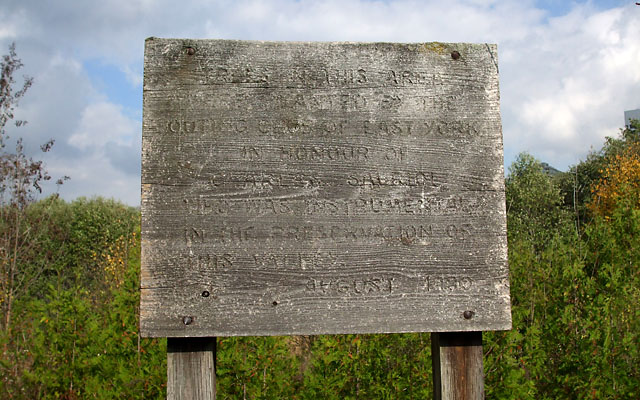
The next time you’re exploring the wooded trails near the marsh in E.T. Seton Park, you may stumble upon a weathered sign overlooking a wet meadow. Still barely legible, it reads:

Trees in this area
were planted by the
Outing Club of East York
in honour of
Charles Sauriol
who was instrumental
in the preservation of
this valley
August 1980

The Outing Club of East York‘s Diane Vieira told me that in its early years, OCEY was very active in planting trees in and around Toronto, including at this location and others in the Don Valley. Unfortunately, they had to stop planting a number of years ago when they could no longer obtain trees from the Ministry of Natural Resources.

Charles Sauriol is best known to Torontonians—especially east enders and naturalists—as the man who spent virtually his entire life fighting to preserve and enhance the Valley’s natural heritage. His half-dozen books, including Remembering the Don, Tales of the Don, and Pioneers of the Don, together form the closest thing we have to a definitive cultural history of the Don Valley.

Named a member of the Order of Canada in 1989, Sauriol’s contributions have been recognized in parkettes, conservation areas, and even an annual fundraising dinner all named in his honour. I can’t help but think that of everything bearing his name, Sauriol would be most proud of the little sign that gets a little more lost in the budding wilderness of the Don each year.

Related: Joe Cooper wrote about OCEY in last week’s East York-Riverdale Mirror.

A version of this article originally appeared on Torontoist.
A real man's SUV

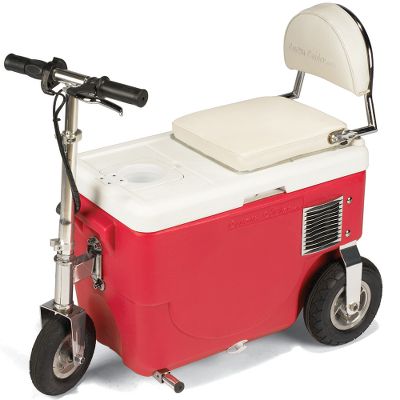
Best scooter ever. I can’t decide whether this beauty from the latest Hammacher Schlemmer catalogue is the best sport utility vehicle ever or a mere curiosity. It doesn’t really matter either way, because I really want one.

With a range of 15 miles (24 km), it could handily transport me and my lunch to work on those rare days when I really don’t feel like cycling. But I imagine its primary use in my life being for grocery shopping, picnicking, making Risa embarrassed to be seen with me, and impressing the hell out of the neighbours.

A vehicle like this reduces motorized personal transportation to its essence: wheels, an electric motor, and a trunk to carry your stuff. Most people don’t need more than that for commuting and running errands. And just imagine the jaws dropping when you steer this sweet ride up to your next tailgate party.

Image from Hammacher Schlemmer.