Feed on
Posts
Comments

Archive for the 'Heritage' Category

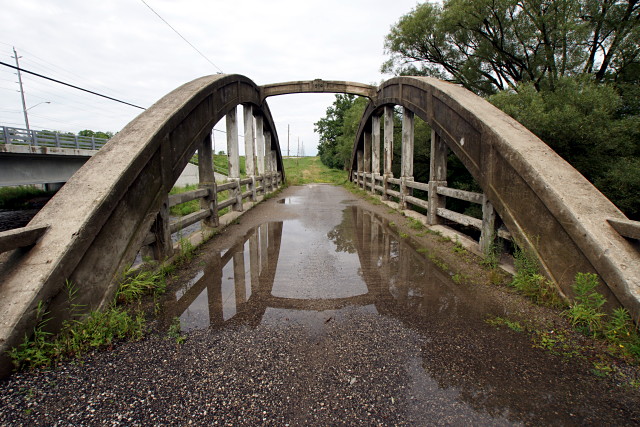
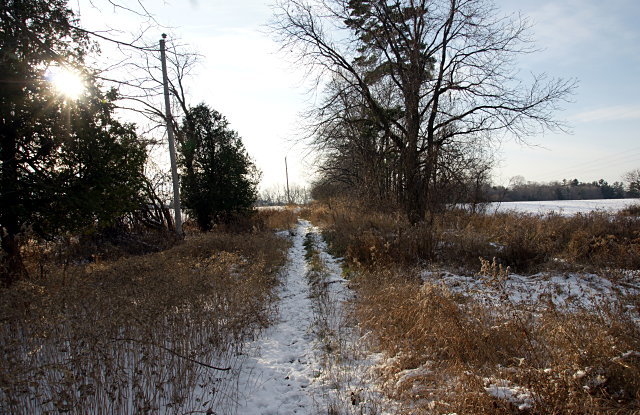
Indian Line looking north from near the CN tracks

Way up in the very northwestern corner of the city, the old Indian Line used to mark the boundary between Etobicoke and Peel Region (Mississauga and Brampton). The road carved its way through farm fields and across a bridge over the Humber River before continuing north past Steeles Avenue. Most of the old road was effectively wiped out by the initial construction and subsequent widening and extending of Highway 427 starting in the late 1960s and continuing through the early 1990s. Other portions of the road fell victim to realignments of Albion Road, Steeles Avenue, and Regional Road 50 heading north out of the city. But as with other abandoned roads in the city, a few stretches of the old roadway still exist. A tour and more pictures follow.

(more…)

Permalink

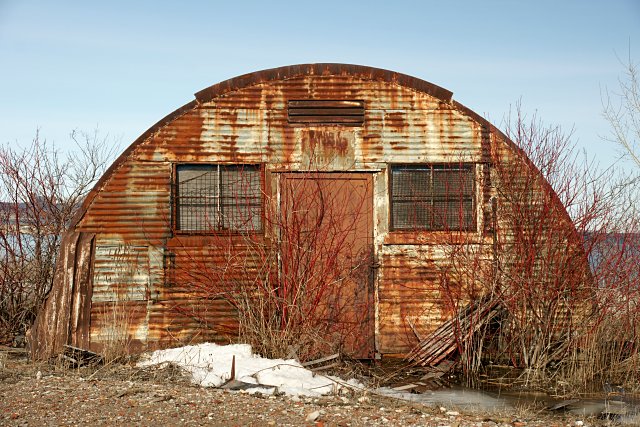
Quonset Hut on the Leslie Street Spit

This old Quonset hut is familiar to anyone who has gone for a stroll or bike ride on the Leslie Street Spit. Shawn Micallef wrote an article in the Star last fall about the history of Quonsets in general and this one in particular:

Above the front door are the faded words “Testing Building.” It once housed the Toronto Port Authority’s gauge for measuring lake levels.

It has played a role in films over the years, including Bulletproof Monk and Canadian Bacon. For the 2006 Michael Douglas film, The Sentinel, it was converted into an east coast fishing shanty, complete with lobster traps.

Shawn also reports that the Quonset will be demolished and a proper visitor centre erected in its place. Although the building is obviously past its best-before date, I’ll still miss it when it’s gone.

Tomorrow: the final edition of Spring on the Spit.

Permalink

Somewhat related to my previous post, Pottery Road has a little-known connection to another Toronto street: Davenport Road. The East York Library monograph Fascinating Facts About East York (and some of them really are, at least to east-end geeks like me) says that Pottery Road:

may have been a part of an old Indian trail that crossed the city along what is now Davenport Road and entered the Don Valley through the Rosedale Valley ravine. There are records of the Mississauga Indians having encamped on the Don near Pottery Road as late as 1831.

I always find it interesting that so much of our modern infrastructure follows old trails, watercourses, and terrain, even decades or centuries after after the old features have ceased to exist on any meaningful level. Technology may have brought us huge bridges across the valley and personal motorized transportation, yet there’s Pottery Road, tracing an old footpath in the Don and still used by thousands of people a day. Some things never change.

Permalink

The natural progression of an early flight

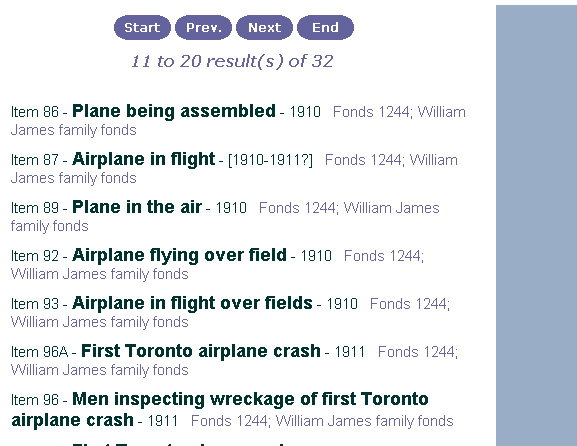
A recent search (completely unrelated to airplanes, strangely enough) on the Toronto Archives turned up the above results, seemingly telling a tragic story in point form. Who says that search engines don’t have senses of humour?

Permalink

Pottery Road

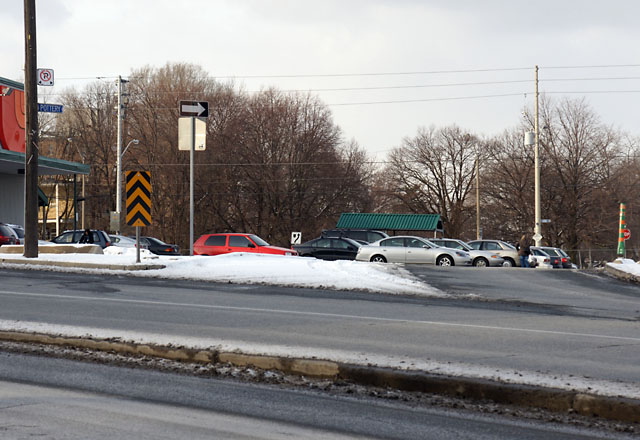
Frequent northbound travellers on the Bayview Extension have probably noticed the “Pottery Road” street sign pointing to a glorified supermarket driveway at the top of the hill, just south of Moore Avenue. Some may even have wondered how it relates to the more familiar street of the same name almost 1.5 kilometers to the south, winding up the valley wall to Broadview Avenue. The answer to this puzzle is that the two Pottery Roads used to be one, connecting Broadview and Moore Avenues, roughly following Cudmore Creek for much of its length.

Most of the road was abandoned when the Bayview Extension was constructed in the late 1950s. The section running from Broadview to Bayview was left mostly intact (and the top of it was later realigned to allow an easier climb out of the valley), as was a very short block at the northern end of the road, now flanked by parking lots for a supermarket and a bank.

What about the kilometer of the road that used to connect the two remaining sections? Unlike most abandoned roads that exist only for short stretches of their former selves, old Pottery Road is unique: its entire original route from Broadview to Moore is still open and can be hiked from beginning to end. Read on for the complete walking tour.

(more…)

Permalink

Dodge Boat Works

Dodge Water Car

I went to the Toronto Boat Show last week, armed with a “working press” badge that allowed me into a semi-restricted area for the wakeboarding demonstration on the big indoor lake. Fun.

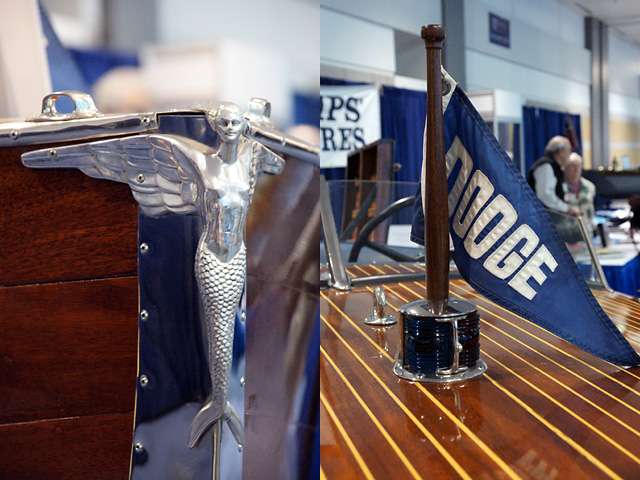
The Antique and Classic Boat Society, Toronto Chapter had a large display outside the show featuring, well, antique and classic boats. One in particular caught my eye, the oddly-named Dodge Watercar from the Dodge Boat Works. Founded by Horace Dodge Jr., son of one of the brothers who established the eponymous automobile company, the Dodge Boat Works shut down in 1936 after just 12 years of production, never quite able to translate the automobile company’s achievements on the road into the same kind of success on the water. You can read the full story of Horace Jr. and the Dodge Boat Works in the Summer 2002 issue of Rudder, the quarterly magazine of the Antique and Classic Boat Society (not the Toronto Chapter).

Permalink

Time Moose Scape goes dumpster diving

You remember the Moose in the City, don’t you? For six glorious months in 2000 more than three hundred moose statues stood watch over Toronto, succesfully saving us from the shame of having flying pigs instead. Although some locals didn’t fully appreciate the fibreglass wildlife, I’d rather have the moose than any of the subsequent visitors to our fair city, including aphids, SARS, and Chilean soccer players.

Rudolph the red-nosed mooseMost of the moose had disappeared by the end of the year, but a few can still be found on display around the city. I recently stumbled upon this poor fellow behind the Ontario Science Centre, covered in dust and jammed up against a wall behind piles of discarded shipping pallets and recycling bins, begging for some dignity in retirement.

Time Moose Scape began life sponsored by none other than the very organization that callously threw him outside like so much trash. Oh, he tried to stay on their good side by getting a new paint job, donning a new suit and bow tie, trimming off his gangly antlers, and even going so far as to have a giant red clown nose surgically attached to his snout. It was all for naught. More enamoured by the latest plastination and big boat toys, Time’s masters cruelly cast the gritty seven-year-old out into the world to fend for himself.

Like any abandoned child, Time has remained close to the only home he’s ever known, scrounging for food and affection in the nearby recycling bins, eventually settling among the empty water bottles and flattened cardboard boxes. But despite the hard turns his life has taken, he keeps a smile on his face. That big red nose could have become a mark of his failure, but Time has chosen to wear it as a badge of courage. It proudly proclaims that one day he will be back among the adoring children inside.

A version of this article originally appeared on Torontoist.

Permalink

Sewells Road suspension bridge in Scarborough

Tucked into the northeast corner of Scarborough near the Zoo, Toronto’s only vehicle-carrying suspension bridge straddles the Rouge River. A small handful of other suspension bridges dot the city, but carry only pedestrians and cyclists. Transportation Services was taken by surprise upon my first inquiry and couldn’t immediately confirm that this was a true suspension bridge. But John Bryson, Structures and Expressways Manager for the city, verified that it is indeed a “suspension bridge with the side trusses as stabilizers for the deck.”

Sewells Road suspension bridge in Scarborough

Built in 1912 and one of fewer than 15 bridges listed in Toronto’s inventory of heritage properties, the bridge can be seen by traveling through the Scarborough countryside on Sewells Road north from Old Finch or south from Steeles. Transportation Services also told me that the bridge is due for rehabilitation in the near future and that it may need to be altered from its current form. Best get thee to Scarborough to see it before the bean counters and Leon’s get their mitts on it.

The local scenery in this corner of the city will make you forget that you’re still in Toronto. Unfortunately, the illegally-dumped trash and auto wrecker up the street will remind you that you’re still in Scarborough.

Sewells Road suspension bridge in Scarborough

A version of this article originally appeared on Torontoist.

Permalink

Offroad streetcar

An old PCC in Pickering

I always hear about old streetcars sitting out in farmers’ fields or doing duty as storage sheds in the middle of nowhere, but I’d never seen one for myself until this past weekend. This one is on Finch Ave in Pickering, just east of Scarborough-Pickering Town Line.

I would have gotten in closer for some pictures, but the place was plastered with ‘no trespassing’ signs and there was no one around for me to ask about it. I assume that they’re tired of having transit and photo geeks crawling all over their property, but what do they expect with a rusting old PCC sitting in their front yard?

Permalink