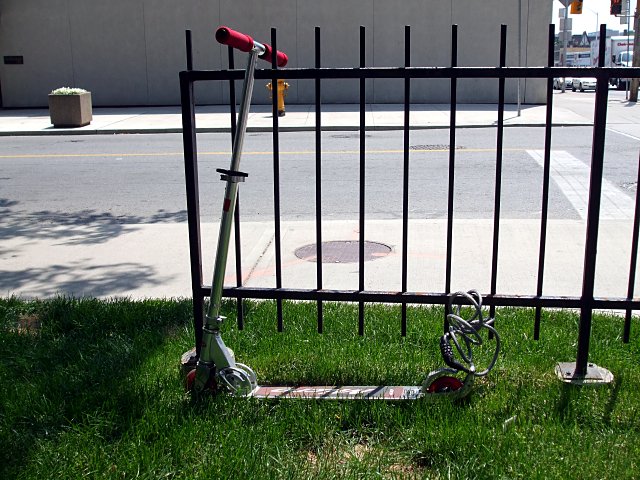
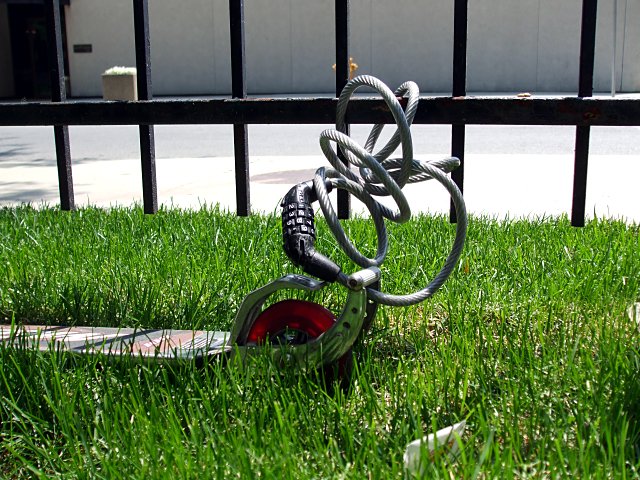
Strangely enough, you don’t hear much about the need for more and better scooter parking facilities. This scooter is locked up at Yonge & Soudan most days.
Random Wanderings and Wonderings
Strangely enough, you don’t hear much about the need for more and better scooter parking facilities. This scooter is locked up at Yonge & Soudan most days.
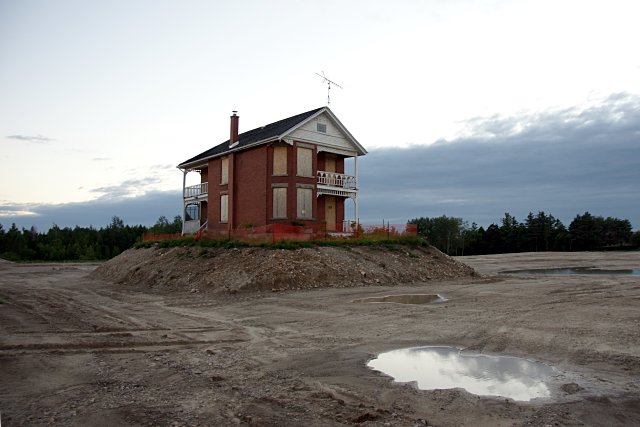
I came across this curious sight out near Guelph this past weekend. The old house, no doubt saved from demolition by a heritage designation, sits in the middle of a large lot that has been scraped clean of soil and flattened for what is sure to be a completely unremarkable subdivision. The patch of soil the house sits on is now maybe 8 feet above the surrounding terrain. The interesting thing is that there’s absolutely no sign of action here: there’s no equipment on site, no sales pavilion, no signs, no building material, nothing. It’s almost like someone just wanted to cart away all the topsoil and leave behind a moonscape.
The view reminded me of this spectacle last year in China.
Here’s an easy question for you trivia buffs: name a popular Toronto Maple Leafs hockey player in the 1960s who went on to found a donut shop that bears his name. Take your best guess, then read on for the answer.
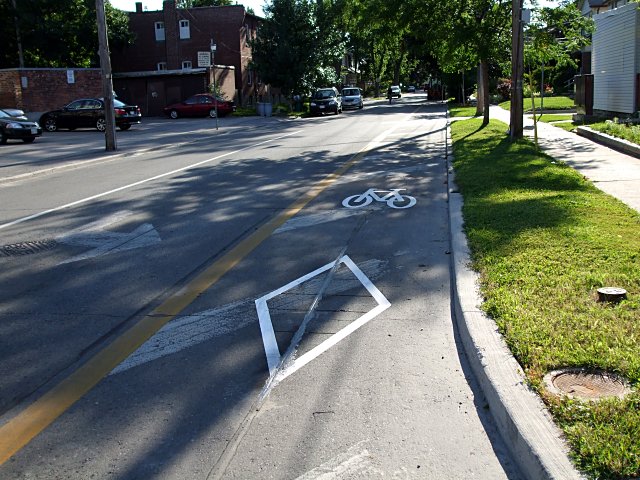
It’s been three months since any progress has been made on the semi-completed bike lane on Chester Hill Road between Broadview and Cambridge Avenues. Just when I was beginning to give up hope that work would ever resume on this project that started way back in November, the lane was finally painted with two diamond and bicycle stencils today. Some work remains to be done—the temporary stop sign at Cambridge needs to be replaced by a permanent sign, and the signs prohibiting turns onto Chester Hill from Broadview must be updated to allow cyclists to make the turn—but once again I have some hope that the lane will be finished before the end of time.
To recap the work done so far:
Late November: A 70 metre line of yellow paint goes down marking the lane. Two bike lane signs are attached to poles, but one of them remains covered by black plastic.
Mid-April: The second sign is uncovered and a temporary stop sign is erected at the Cambridge Avenue end of the lane, held up by three sandbags.
July: Two stencils are painted to mark the lane.
Surely there’s a joke in there somewhere.
At just 70 metres long, this is probably the city’s shortest bike lane. At close to eight months and counting since work started, it’s taking an unbelievably long time to slap down some paint and post some signs. Back in April, I wrote that the early spring progress on this lane was a good sign because the cynic in me had expected completion of the lane to “languish well into the summer.” Um…
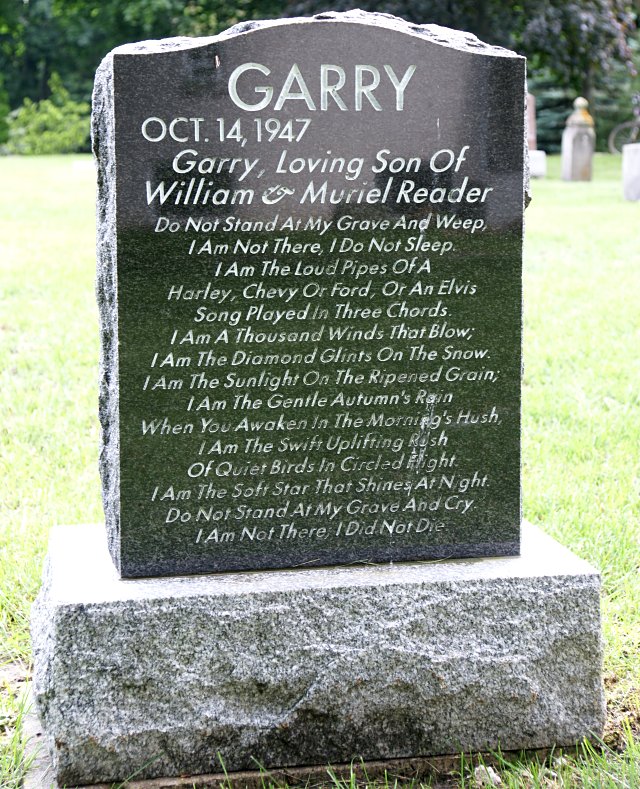
The great thing about what is euphemistically called pre-need funeral planning is that you not only get to pick what goes on your headstone, but you get to admire it yourself. I can only assume that’s the explanation behind this seemingly pre-need headstone in Ashburn‘s Burns Cemetery. The inscribed poem is so familiar that the second rhyming couplet almost slips past without notice:
Do not stand at my grave and weep,
I am not there, I do not sleep.
I am the loud pipes of a Harley, Chevy or Ford,
Or an Elvis song played in three chords.
I like it.
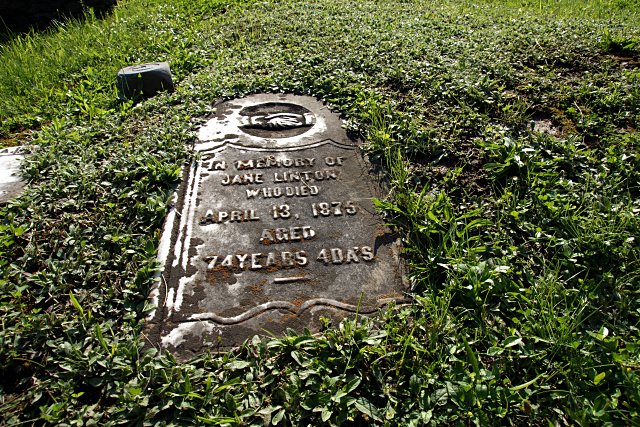
This marker is in Bethel Cemetery in Pickering.
If you walk through any cemetery that’s been in operation for more than a hundred years, you’ll soon notice two things. The first is the sheer number of children that used to die before they were old enough to crawl and how many families had two, three, or more children that didn’t live to their tenth birthdays.
The second is an unusual obsession with precision exhibited on many markers. I can understand marking a dead child’s age as three weeks or 22 days, but many of the markers for older people also include precise counts of months and days. It always seems a little odd to see a grandmother’s age tallied up in the same manner as a toddler’s.
A lot of people shy away from cemeteries, but I always find them fascinating. Taking a stroll through an old cemetery is like walking through a highly-condensed social history of a region. As you progress from older graves to newer ones, the names change, occupations shift, family relationships become clear, and tributes to achievements both major and minor abound.
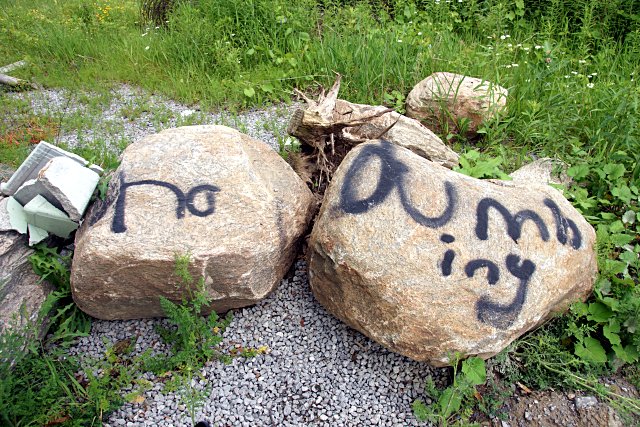
It looks like someone in rural northeastern Pickering has had enough of idiots treating this vacant lot like their own private dumb and has chosen to combat the problem by posting this notice at the entrance. And who can blame the poor owner? No one wants to visit their plot of land only to discover that they’ve been dumbed on again. Do you have any idea how much it costs to clean up after that kind of stupidity?

Awwww.
What are you, made of stone?
This rabbit lives in Mount Pleasant Cemetery. There was also a groundhog hiding under a bush about a metre out of this shot. It kind of makes you wonder what kind of sturdy underground home groundhogs and rabbits could find in a cemetery.
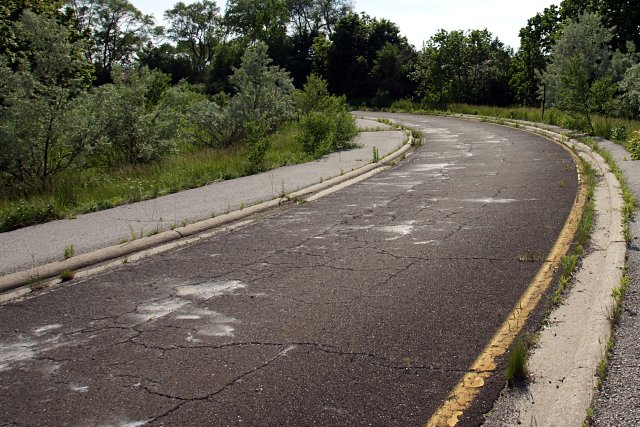
Driving down the DVP a couple of weeks ago, I noticed an old roadway cutting through the brush just north of York Mills Road. I had a pretty good idea of what it was, but a quick look at Google Maps confirmed my suspicion: it was an abandoned on-ramp to the southbound Don Valley Parkway from westbound York Mills Road. The current DVP ramps at York Mills were reconfigured during construction to the overpass beginning in 2005. The northwestern loop of the cloverleaf was removed entirely. Or was it?
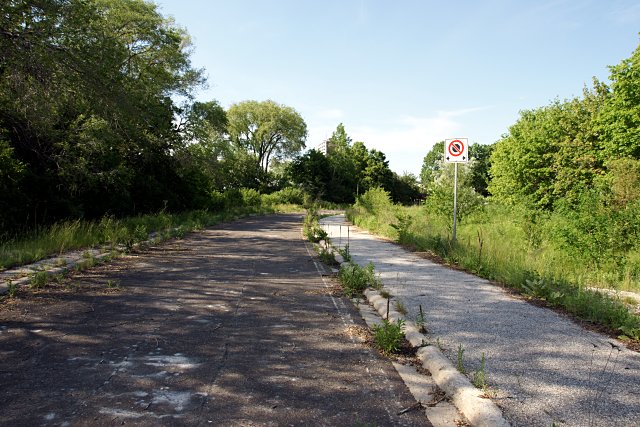
I went back by bike last weekend (the same ride where I blew out a tire) to investigate and was quite surprised by what I found. Not only was virtually the entire ramp still intact, but there had been no attempt to restrict access to it. I was expecting to see the traditional Toronto chain-link fence surrounding the road, but all I had to do was ride up a little hill before I was greeted by the remnants of the ramp in all its glory. I’m not saying that there should be a fence, just that I was expecting one. Toronto officialdom is so paranoid about putting fences and warning signs around everything more challenging than a sidewalk that I never imagined for a second that it wouldn’t be all locked up.
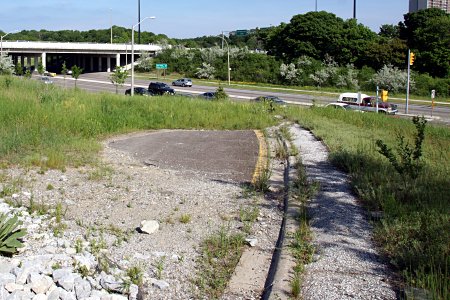 Although the subsequent landscaping at York Mills Road put the ramp’s remnants out of sight, the bulk of the road still sits behind the embankment, where it’s being slowly consumed by encroaching weeds. The posts that held up corrugated beam safety barriers around the perimeter of the ramp were cut down to the ground and a stone-lined drainage ditch has been dug across the roadway, but the ramp is otherwise intact to within a few metres of the highway.
Although you’re never farther than 100 metres from either York Mills or the DVP, the curving tree-lined ramp quickly isolates you from both. Even with the sound of traffic in the background, it’s surprisingly relaxing.
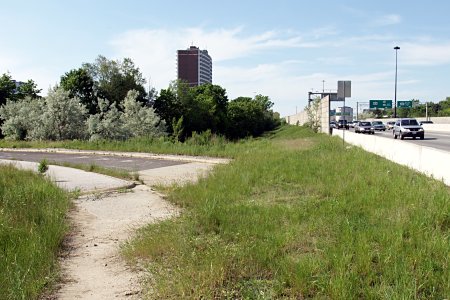 The current Google Maps image of the area, probably taken in 2005 or 2006, clearly shows an excavator perched at the very bottom of the ramp, presumably preparing to rip up the 50 metres or so of the roadway that was removed.
At some point, the now-unused land here will probably be sold off for—what else?—condos, and another little piece of Toronto infrastructure will disappear completely. In the meantime, this hidden corner of the city is being rezoned by the local flora.
A version of this post originally appeared on Torontoist.
Tires are frequently a forgotten aspect of bicycle maintenance and this is what happens when you don’t check them regularly:
First you wear a little hole in your tread: 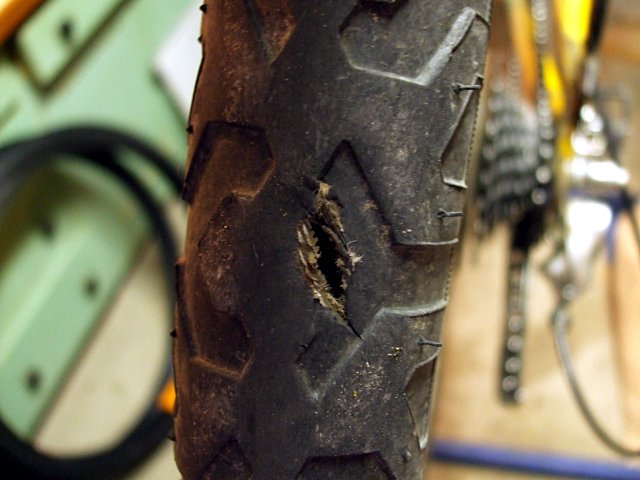
Then your usually indestructible Mr. Tuffy tire liner wears through: 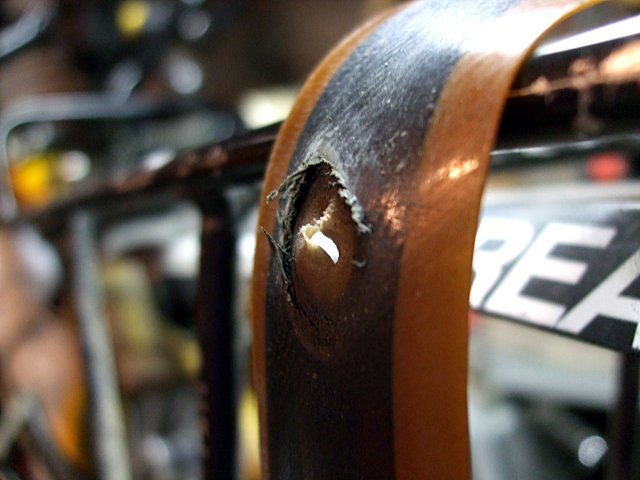
Then your tube blows out while you’re speeding down Don Mills Road:
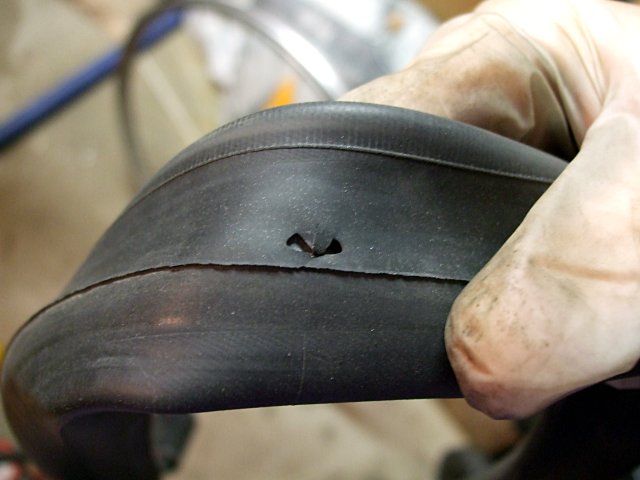
And finally, you call your better half to come and rescue you from the 2-hour walk home.
I can’t complain, though; I knew the tire was nearing the end of its useful life but ignored the now-obvious warnings through a couple of rides. Since 2003, this set of tires had seen about 12,000 km on concrete, asphalt, sand, rocks, dirt, mud, grass, loose gravel, snow, ice, slush, and pretty much every other surface you could encounter in southern Ontario and I’d been planning since the spring to replace them anyway. As usual, I just needed that extra little push to actually get the work done.