Take a (snow) hike

Really big shoe

What’s the most fun you can have in the days following a big snowstorm?

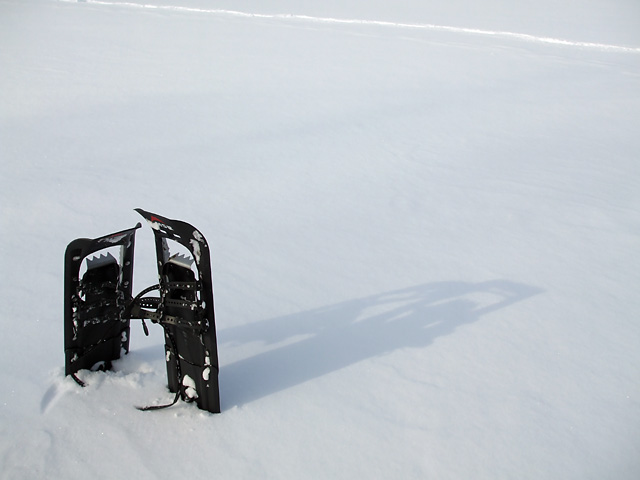
Unlike many winter sports, snowshoeing is relatively inexpensive and requires little in the way of specialized equipment. Other than the snowshoes themselves—a decent pair costs less than a good pair of skates—you need only some warm layers of clothing, a sense of adventure, and as much time as your legs can stand.

It really couldn’t be any easier to learn, either: just strap on your snowshoes and start walking your way to an energizing workout. Or take a slower pace and explore corners of the park where you wouldn’t normally go.

With terrain varying from wide open fields to challenging forested hiking trails, Toronto’s Rouge, Don, and Humber Valleys (not to mention dozens of smaller ravines and parks around the city) offer prime snowshoeing opportunities without requiring travel outside the city. If you live or work close to a suitable park, snowshoeing is hard to beat as a lunchtime fitness activity. It’s mind-clearing and relaxing, and leaves you ready to tackle whatever boredom awaits you at the office in the afternoon.

The only real barrier to snowshoeing in the city is Toronto’s wimpy weather: with frequent thaw cycles throughout the winter, ideal snowshoeing conditions usually only last for a few days after a big storm before all the snow starts melting away into slush.

If you feel the need to go farther afield and escape the city, check out the offerings of a local organization like the Toronto Bruce Trail Club or Outing Club of East York for group snowshoe hikes through conservation areas or resorts outside the city. From the base of frozen Webster’s Falls to the top of Rattlesnake Point, there’s no shortage of snowshoeing challenges in and around the GTA. Sites outside Toronto usually hang onto their snow longer than we do in the city, but you should always check conditions at your destination before heading out.

What if you don’t have snowshoes and don’t want to buy them? You can always rent from the MEC or one of many winter resorts in southern Ontario. For those inclined to frugality or craftiness, there are do-it-yourself instructions available online for several different varieties of snowshoes. You have no excuse not to try it.

So what’s the most fun you can have in the days following a big snowstorm? Tobogganing, of course. Snowshoeing doesn’t even come close, but it’s still fun in its own way.

A version of this article originally appeared on Torontoist.
Rink in the raw

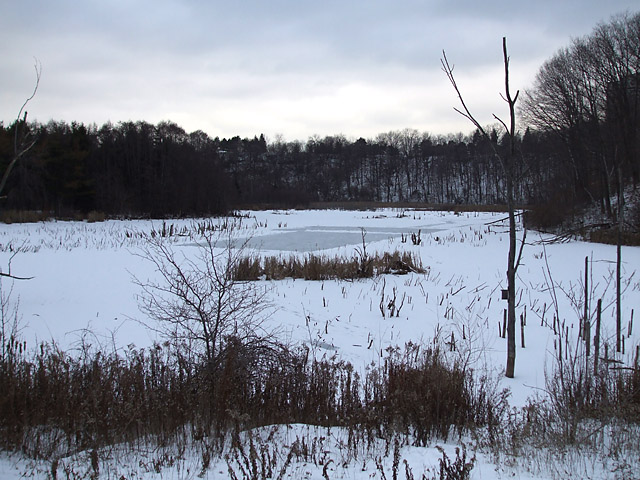
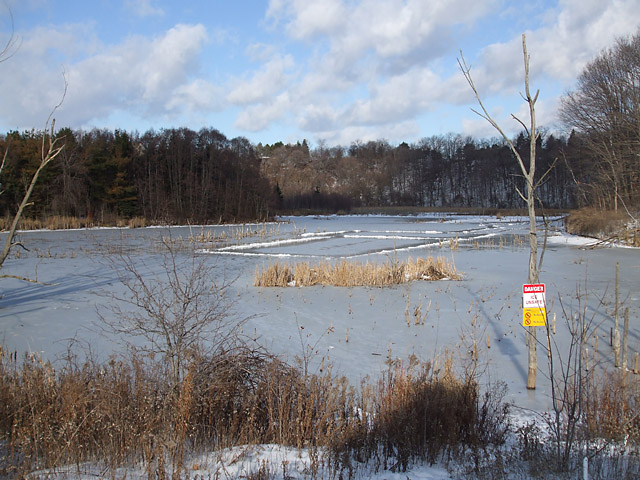
Natural ice rink in E.T. Seton Park

There’s something about the sight of a natural skating rink that warms the heart. I noticed on Monday that someone had cleared a good-sized rink on the marsh in E.T. Seton Park. The marsh was pretty completely frozen over last week and I wondered how suitable it would be for skating. I guess someone found out.

Natural ice rink in E.T. Seton Park, gone until the next freeze

Of course, by Wednesday, the party poopers at the City had put up new “Ice Unsafe” and “No Skating” signs and melted all of the ice. Those fun-hating bastages. I don’t mind the signs so much, but they could have left the rink intact.

Despite the relative deep freeze of the last couple of weeks, I think it was still a little early to be heading out on natural ice. The ice looked solid even on Monday, but I wasn’t going anywhere near it. Call me paranoid, but I can wait until a proper January freeze.

The “No Skating” signs include a hand-lettered reference to Chapter 608 of the Toronto Municipal Code, section 21B of which states that, “No person shall access or skate on a natural ice surface in a park where it is posted to prohibit it.” Are there any natural ice surfaces in Toronto that don’t get “No Skating” signs posted every winter? Last I heard, even Grenadier Pond gets this treatment. Signs also line the banks of the Don River, and I can’t remember ever seeing that chemical soup frozen over. I did snowshoe across Taylor Creek once a few years ago, but only because I knew the river was about three inches deep below the ice.

Walking in a winter wonderland

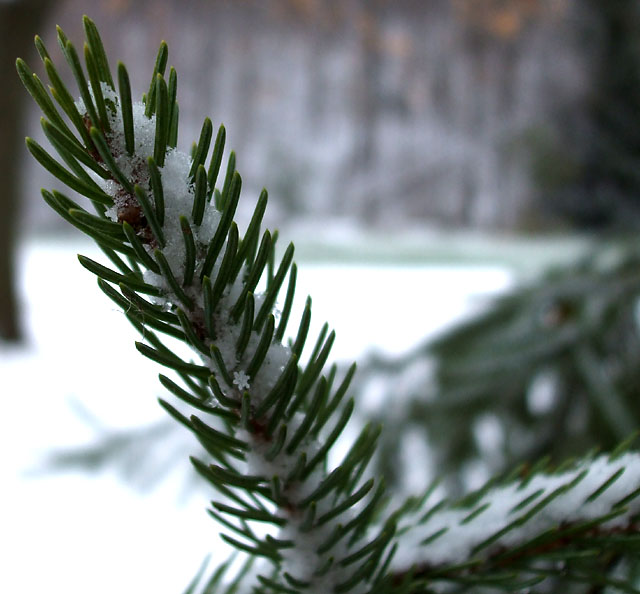
Snow-dusted pine tree

Ah, the first snowfall of the year. This is one of my favourite times to walk in the Don Valley. This stretch of E.T. Seton Park is normally quite well used, even during the constant rain of the last few weeks. But I only saw one other set of bootprints along the snow-covered path today, and a single lonely bicycle track heading south. There were more deer tracks (3) than car tire tracks (none) in the two parking lots I passed.

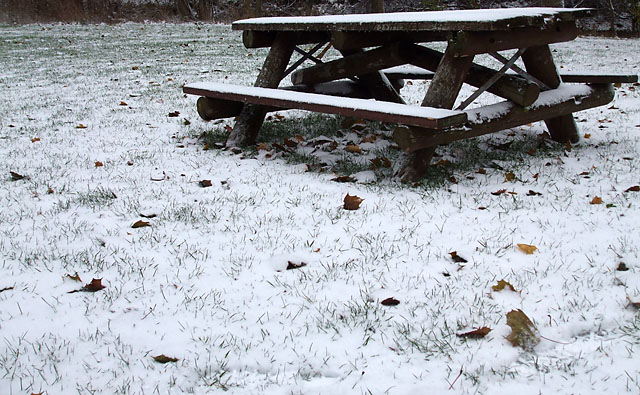
Snow-dusted picnic table

I usually take my daily lunchtime constitutional in this section of the park (those familiar with the area may have noticed that many of my posts originate in E.T. Seton Park and environs), which is quite well shielded from the worst of the weather that rages outside the valley walls, allowing a nice relaxing walk on all but the most blustery of days. The walking choices in this single area vary from a forested hiking trail to scenic trails around a marsh to a paved level path traversing the length of the park. I took the easy route today. Though I was never more than a couple of hundred metres away from the traffic and slush above, I couldn’t hear a sound other than the crunching of my boots in the fresh snow. That’s what winter’s all about.

A mystery no more

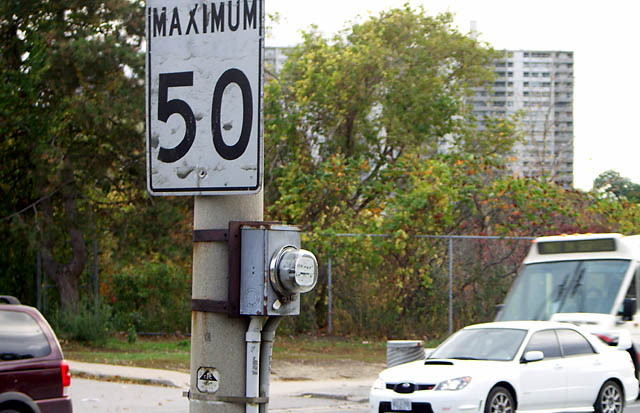
Meter on a stick

A few weeks ago, I wondered about the presence of electricity meters placed randomly around the city, measuring power consumption for, well, something or other. After noticing more and more of these as I rode and walked the city this spring and summer, I felt compelled to ask Toronto Hydro for more information.

They finally responded to my query earlier this week, going well beyond what I expected by sending a supervisor out to examine one of the mystery locations. He reported back that the meter on Overlea Boulevard near Don Mills Road (pictured above) is for the City’s Works department, and is most likely hooked up to a sump pump in a chamber below street level. The same is probably true of another meter at Kingston Road & Celeste Drive that I’d asked about. This kind of installation is rather common.

Another mystery solved. I still think that my curiosity will eventually earn me a visit from some Men in Black, but I seem to have escaped that fate so far.

A version of this article originally appeared on Torontoist.
Who did Jesus's 'do?

Jesus is the answer

This barber is located on Finch Ave. between Weston Rd. and Islington Ave. If the question is, “Who’s going to cut my hair?” I’m pretty sure the answer is wrong. If the question is, “Who’s upstairs at the ‘aroma massage’ place?” I’ll give 50-50 odds.

The metered city

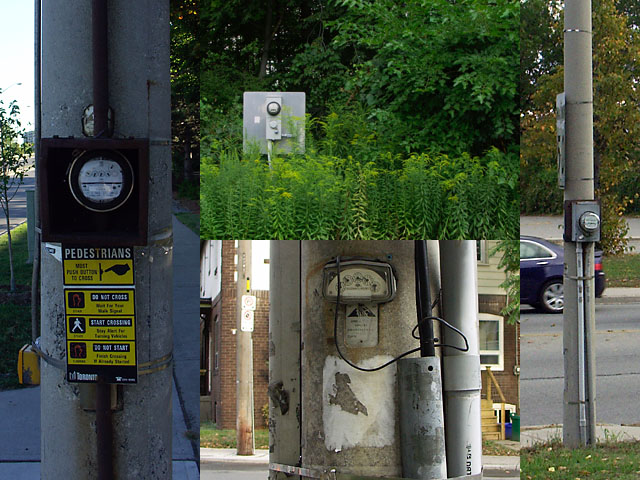
A medley of meters standing watch over…something or other.

Our modern urban infrastructure is so pervasive that most of it goes virtually unnoticed. But every once in a while, something appears just out of place enough to make you stop and wonder what it’s doing there. For example, an electricity meter strapped to a light pole directly above a pedestrian “push to cross” button, its familiar flat disk spinning slowly and recording usage of, um, what exactly? Surely it’s not metering the little light that glows after you press the button.

Since first puzzling over that meter at Kingston Road & Celeste Drive earlier this year, I’ve been noticing a lot more of them in odd locations. Some of the places deemed to require monitoring include the edge of a forested park, a hydro pole with big fat conduits leading to a small grey box, and a lamp post with no obvious connection to anything (all pictured above). Unlike meters at cellular or broadcast transmission towers, these don’t seem to be associated with any particular structure or electricity consumer. So what are they measuring, and for whom? It’s a bit of a mystery.

Sadly, Toronto Hydro hasn’t yet responded to my week-old query about the purpose of these seemingly random meters. Whenever I call or email someone to ask for an explanation or clarification about some obscure piece of infrastructure, I feel like I’m more likely to be put on a terrorist watch list than I am to get an answer. I wonder if The Fixer and Urban Decoder ever feel that way.

A version of this article originally appeared on Torontoist.
Just monkeying around

How’s it hanging?

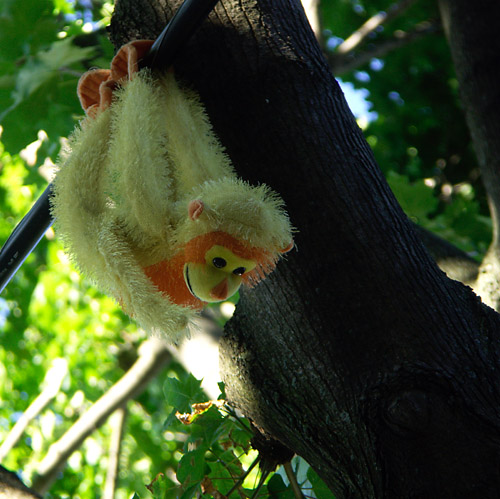
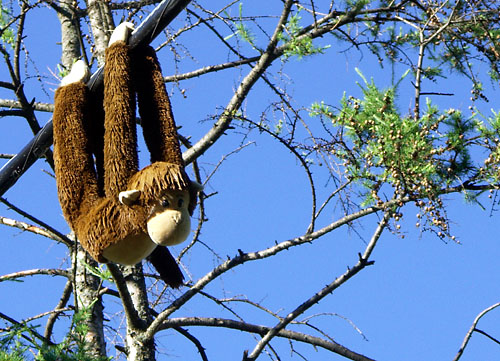
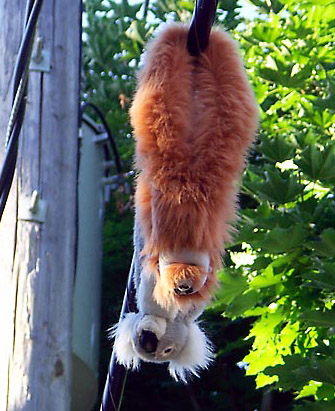
One of my neighbours keeps monkeys, hanging them from the utility wires along the street. There were only a few until last year, when the population exploded to the current dozen or so lining almost the entire block.

Shortly after we all learned through a Fixer column last year that one of the locals was taking the proliferation of monkeys a little too personally, a petition was affixed to the pole closest to the monkeys’ home pleading for the continued presence of the playful primates.

Watching the world And a koala too

The monkeys have since spread so far along the street that it’s hard to miss them unless you’re staring at your feet for the entire block. So I have to admit to a bit of amusement at learning that the Toronto Psychogeography Society walked right past without seeing them last week.

In fairness, many of the monkeys were camouflaged by trees at the time and the Society did their stroll under cover of darkness.

A version of this article originally appeared on Torontoist.
Life out of balance

(I liked the headline from my recent Torontoist post on the same subject that I’m reusing it.)

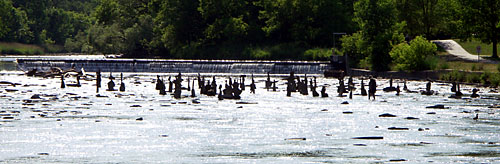
Rock towers in the Humber River
Peter Riedel could hardly have chosen a better location to ply his trade. I’ve seen rock balancers in the eastern beaches, in the western beaches, and even at the Ex, but this is the first time I’ve seen one working the Humber River. Literally in the river.

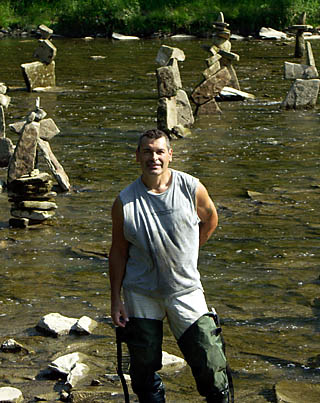
The artist and some of his creationsThe Humber cascades over a low waterfall in Étienne Brûlé Park before bubbling just a few centimetres deep across a short stretch of river rock. The only sounds here come from the rushing river and picnicking families. Visitors to the park on a busy Sunday afternoon include cyclists, walkers, joggers, and skaters. And then there’s the guy crouched in the middle of the river with a rock in his hands, surrounded by some 50 rock towers of every imaginable description.

Riedel, who has been balancing rocks on the Sunnyside Beach seawall for three seasons, recently moved up the Humber to take advantage of the idyllic setting, the abundant raw material, and the permanence the river lends to his work. He found Sunnyside less than ideal with the constant din of nearby traffic on Lake Shore and the Gardiner breaking his concentration and the constant danger that his towers would be toppled by careless passersby and malcontents. In contrast, it’s hard to imagine anyone accidentally bumping into a rock tower in the middle of a river.

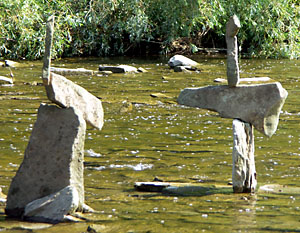
The phallic sectionDaryl Maddeaux, who builds impressive towers at the Ex and other special events, once answered a query from the crowd by saying that rock balancing is more about patience than skill, and that anyone could do it. Since then, I’ve always wanted to try my hand at it. Unfortunately, I’m fairly certain that I don’t have the patience. For the moment, I’ll settle for the home version I received as a gift last year.

50 perfectly-balanced towers in the river

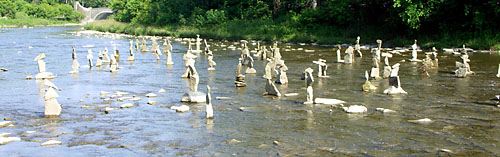
More than 50 towers dotted the river by the time Peter was done that day.

The view from afar

From afar and backlit, the towers look like people standing in the river. Only one of them in the picture above actually is a person.

There’s no trickery involved in rock balancing, just patience, skill, and artistry. Maddeaux always makes a point of knocking down his towers at the Ex by lobbing little pebbles at them, to demonstrate that the towers are held together by nothing but gravity and even the slightest shift will topple them. Life, out of balance.

A version of this article originally appeared on Torontoist.
The monuments of Scarborough

I posted about Scarborough’s own version of the CN Tower a few weeks ago, which the Summer 2007 issue of Spacing says will soon be torn down. The Scarborough Tower that is, not the CN Tower. Little did I know that the Scarborough Tower was just the beginning.

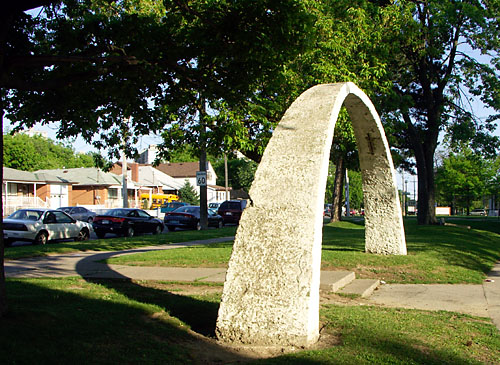
The Scarborough Arch

I was delighted to discover recently that Scarborough boasts its own version of St. Louis’s Gateway Arch. Rising an impressive 2.5 metres above the pathway on Midland Ave and offering commanding views of the nearby sidewalk, the arch truimphantly marks the symbolic gateway to the Midland Court Apartments and commemorates the relentless Eastward Expansion of the city. (If you look closely at the Google satellite photo, you can see the graceful outline of the arch just to the left of the green arrow in the middle of the map.)

All manner of monuments, attractions, and landmarks dot the Scarborough landscape, many of them recalling the style of more famous brethren. Think Miniature Village without the tourists (much as it was during its final years). Or Las Vegas without the glitz.